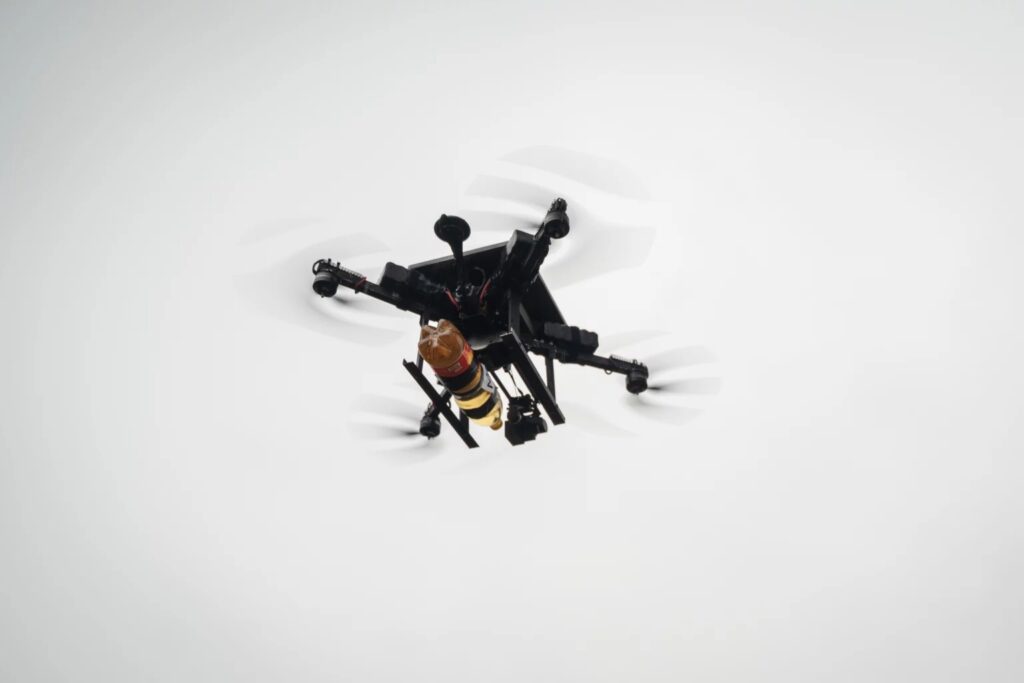
Ukraine’s government-backed defense innovation grant program, known as the “Brave1 technology cluster,” has conducted comprehensive tests of over a dozen small first-person view (FPV) bombing drones designed to fill the niche currently dominated by Chinese-made Mavic drones.
Drone warfare innovations have become a defining feature of the ongoing Russo-Ukrainian war. Unmanned vehicles of various sizes, operating in the air, on land, and at sea, play a central role, with technology advancing rapidly from both sides.
According to a press release obtained by Militarnyi, the tests were designed to assess the drones’ ability to operate effectively under electronic warfare conditions, verify their payload capacity, and determine their practicality in combat situations.
The test protocol tasked each drone with flying 10 kilometers under electronic warfare interference, dropping munitions on target, and returning safely. 14 FPV bombers, sized between 10 and 18 inches, took part, with several meeting all objectives.
These tests are particularly significant as FPV bombers represent a cost-effective tool for targeting enemy personnel and fortifications. Their advantages include low price, ability to carry munitions weighing up to 3 kg, and potential for multiple uses.
To support the effective integration of bombing drones into Ukrainian military operations, Brave1 held the trials alongside specialists from Ukraine’s Security and Defense Forces. Joint testing and experience sharing will help manufacturers refine the drones to meet real battlefield needs.
Ukrainian Mavic alternatives
In November 2024, Ukraine’s Ministry of Strategic Industries held its first event aimed at finding domestic alternatives to Chinese DJI Mavic 3 drones, which dominate tactical reconnaissance in the Ukrainian military.
Militarnyi says eight Ukrainian companies showcased potential replacements, including Kruk, Yautja, PD10ND, Roksoliana, Ukropter, ZOOM, Ptakh-S, and Shmavic. By that time, Ukropter, ZOOM, Ptakh-S, and Shmavic had either completed testing and received codification or were undergoing the process, allowing future procurement through government contracts.
Public information on their deployment remains scarce, according to Militarnyi. However, in mid-April, reports indicated that the 419th Separate Battalion of Unmanned Systems was actively testing the Shmavic drone within its ranks.
You could close this page. Or you could join our community and help us produce more materials like this.
We keep our reporting open and accessible to everyone because we believe in the power of free information. This is why our small, cost-effective team depends on the support of readers like you to bring deliver timely news, quality analysis, and on-the-ground reports about Russia's war against Ukraine and Ukraine's struggle to build a democratic society.
A little bit goes a long way: for as little as the cost of one cup of coffee a month, you can help build bridges between Ukraine and the rest of the world, plus become a co-creator and vote for topics we should cover next.
Become a patron or see other ways to
support.
Become a Patron!