In Other Worlds at the Barbican: Is this what the future looks like?
In Other Worlds | The Barbican | ★★★★☆
The Barbican seems to have found its groove when it comes to contemporary art, utilising its modernist spaces to create sprawling, immersive exhibitions that couldn’t exist anywhere else.
Last year Feel the Sound explored the concept of noise in all of its forms – scientific, spiritual, cultural – inviting visitors to interact with a series of gadgets and algorithms as they snaked from the Curve Gallery and into the bowels of the building.
In Other Worlds takes a similar tack, this time presenting a vision of the not-too-distant future in which visitors wander through various elements of a strange new world. It begins amid the rocks and rubble of a post-apocalyptic cave network, where the silicon minds of machines have permeated the very rocks, creating new sentient beings.
In this place, where the earth itself is literally alive, humans are forced to reconsider their roles, donning protective suits as they slowly reclaim what’s left of the industrial landscape.
As you wander past scale models and huge projections, you’re encouraged to listen to audio recordings that bring the concepts to life. Director Liam Young has collaborated with both actors and activists, who read aloud surreal vignettes: Jeffrey Wright narrates a story of a blind man living alone in a cave with an ageing AI that dreams of hearing whale song before its components degrade. Others are voiced by Richard Ayoade, Denise Gough and Maxine Peake, who lend gravitas and pathos to these tales.
In Other Worlds: The future sucks
My favourite is a story about a project to send AI uploads of earth’s greatest minds – a scientist, a poet, a mathematician, etcetera, etcetera – into space. A team constructs a giant gold spacecraft designed to float for millions of years, ready to be discovered by another civilisation long after mankind has gone extinct. An engineer on the project goes rogue and immortalises his girlfriend instead, ditching the poet (of course) and uploading her personality in their place – only he forgets to activate ‘sleep mode’ and she floats alone and awake for hundreds of thousands of years, going slowly insane.
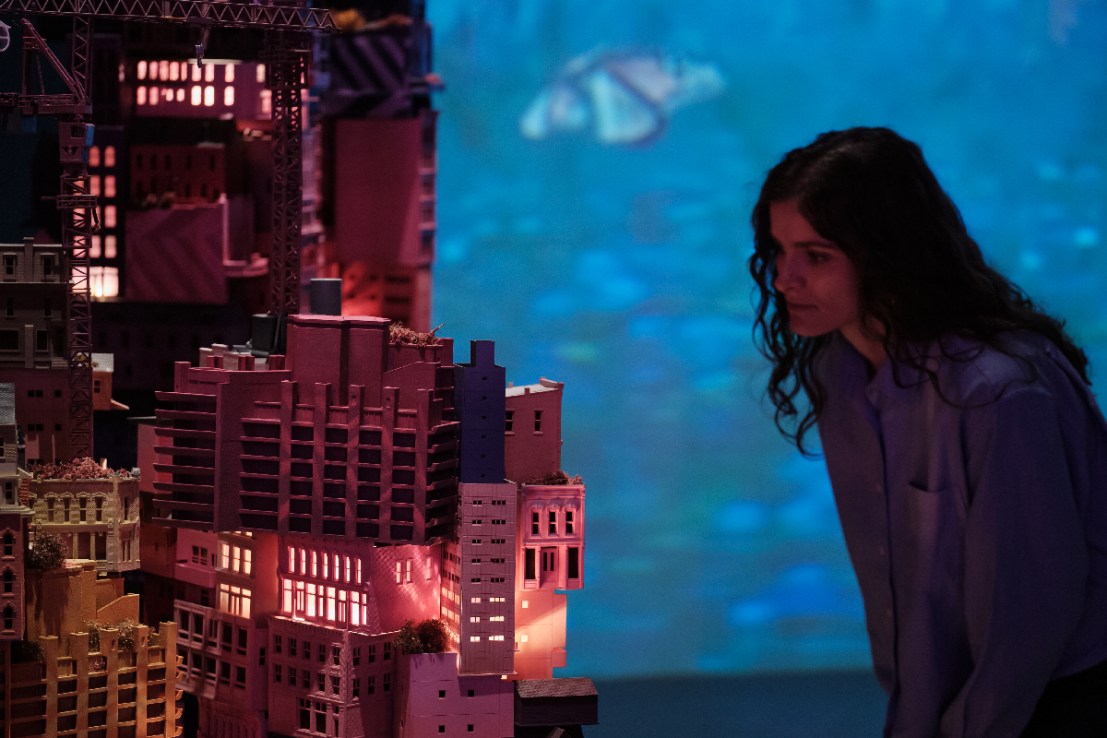
The visuals change as you pass through the exhibition, shifting from a towering city among the trees where people have learned to live harmoniously with the environment to a water-based society where humans care for the ocean instead of polluting it and the reclaimed, oil-stained deserts of a future Australia.
The exhibition wears its influences on its sleeve, with animations Fantastic Planet (1973) and Scavenger’s Reign (2023) both coming to mind, alongside Denis Villeneuve’s Dune films and countless other sci-fi movies.
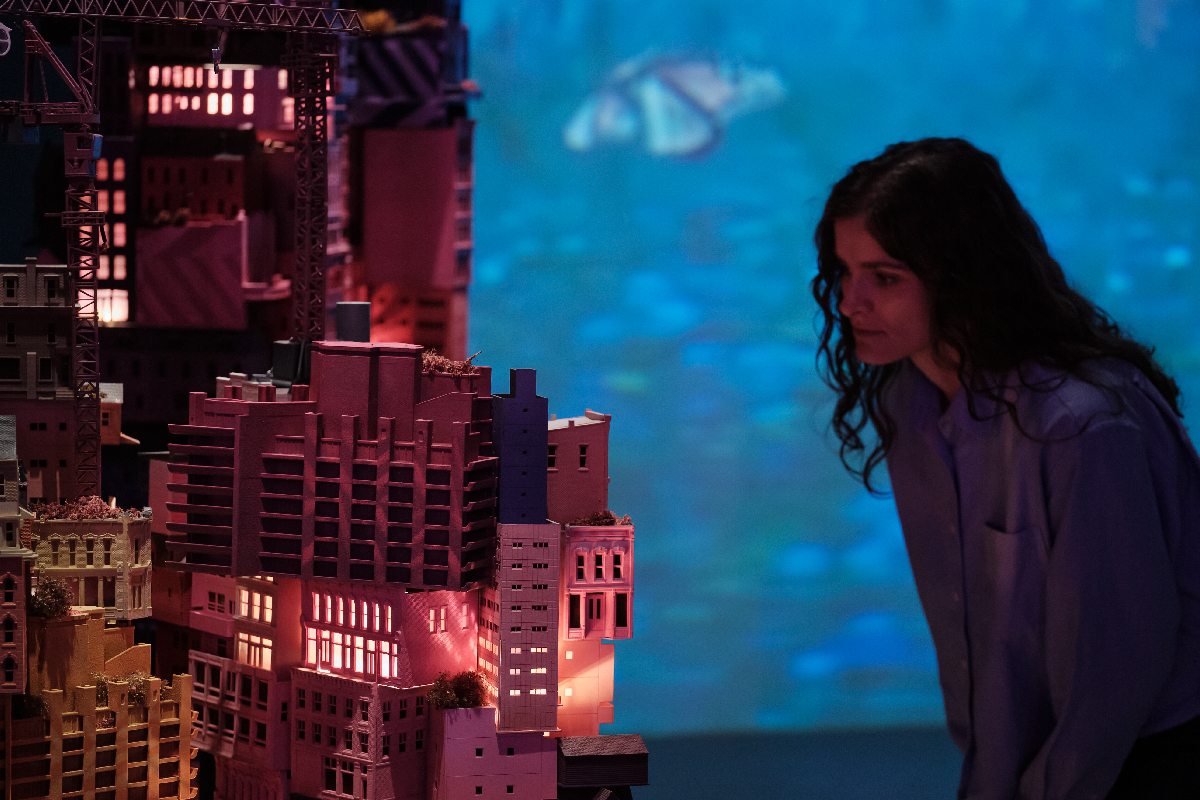
Amidst 12 metre projections and tapestries and futuristic costumes you can find impossibly detailed scale models – ‘movie miniatures’ – which give you a sense of both the scale of this world and the diminished influence of mankind within it.
The themes of the exhibition – the dangers of climate change, the importance of environmentalism, the necessity to use technology to help the planet rather than strip it of resources – are not subtle, and there’s a “real-world” section showcasing green tech and vertical farming practices that feels unnecessarily heavy handed: you’d have to be blindfolded to have missed those points.
But for the most part, In Other Worlds is a powerful, meditative glimpse at a possible future that we would all do well to avoid.
• In Other Worlds is on until 6 September at the Barbican