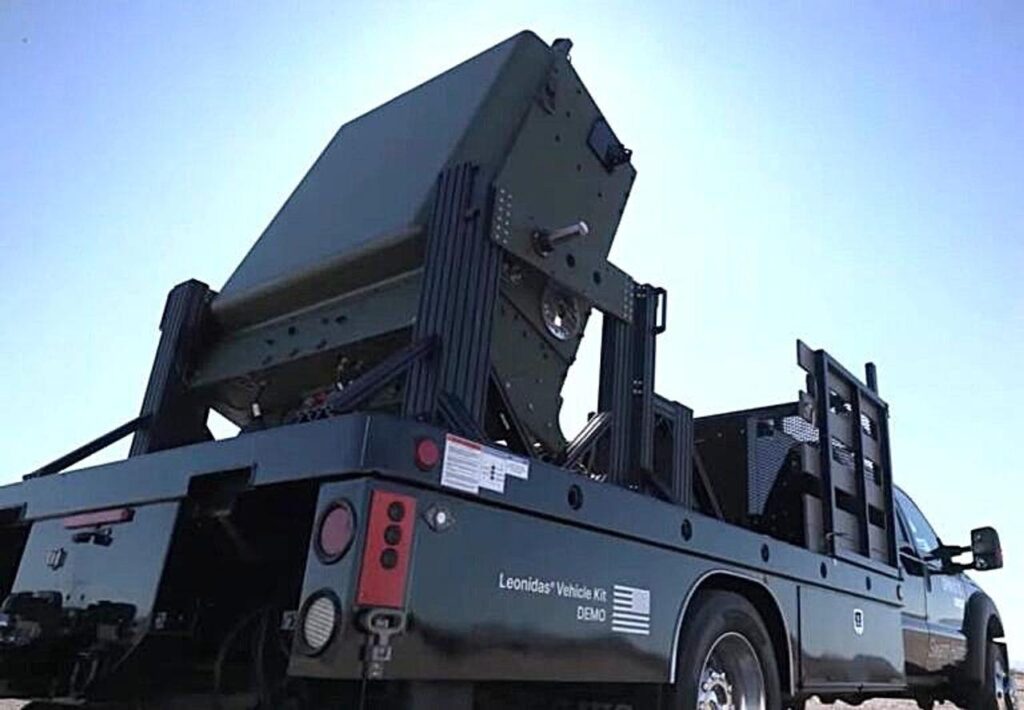
The US-developed Leonidas VehicleKit platform has, for the first time, disabled a fiber-optic-controlled UAV, demonstrating the ability to engage such targets using electromagnetic radiation. These drones can pose a threat to logistics at distances of up to 50 km, Army Inform reports.
It is precisely such engagement ranges that Ukrainian Defense Minister
Mykhailo Fedorov previously
referred to. In an interview with
Business Insider, he noted that fiber-optic drones use coils of long, thin cables that ensure stable communication with the pilot.
It makes them effectively immune to electronic warfare systems and, therefore, more dangerous in combat conditions.
Unlike conventional drones, these systems rely on fiber-optic cables instead of radio links, making them largely invulnerable to traditional electronic warfare.
Drones that couldn’t be jammed are no longer untouchable
Representatives of Epirus stated that this is the first known case of electromagnetic weapons being used against fiber-optic-controlled UAVs.
Previously, such drones were considered nearly “invulnerable” because their connection to the operator does not depend on radio channels and cannot be jammed by standard EW systems, as per Army Recognition.
Strike not on signal, but on drone’s “brain”
Unlike conventional approaches, the Leonidas system does not attempt to disrupt communication between the operator and the drone.
Instead, it directly affects the drone’s electronics — flight controllers, power systems, processors, and other critical components.
This involves generating powerful electromagnetic pulses that cause malfunctions or a complete shutdown of onboard systems.
Even if the cable connection remains intact, the drone loses its ability to function.
Seconds that determine everything
According to the company, the effect of high-power microwave (HPM) weapons is nearly instantaneous.
This is critical in scenarios where FPV drones operate at low altitudes, rapidly approach targets, and leave minimal time for reaction.
Rapid “shutdown” not only neutralizes the drone but can also partially control the crash site, which is important for protecting bases and urban infrastructure.