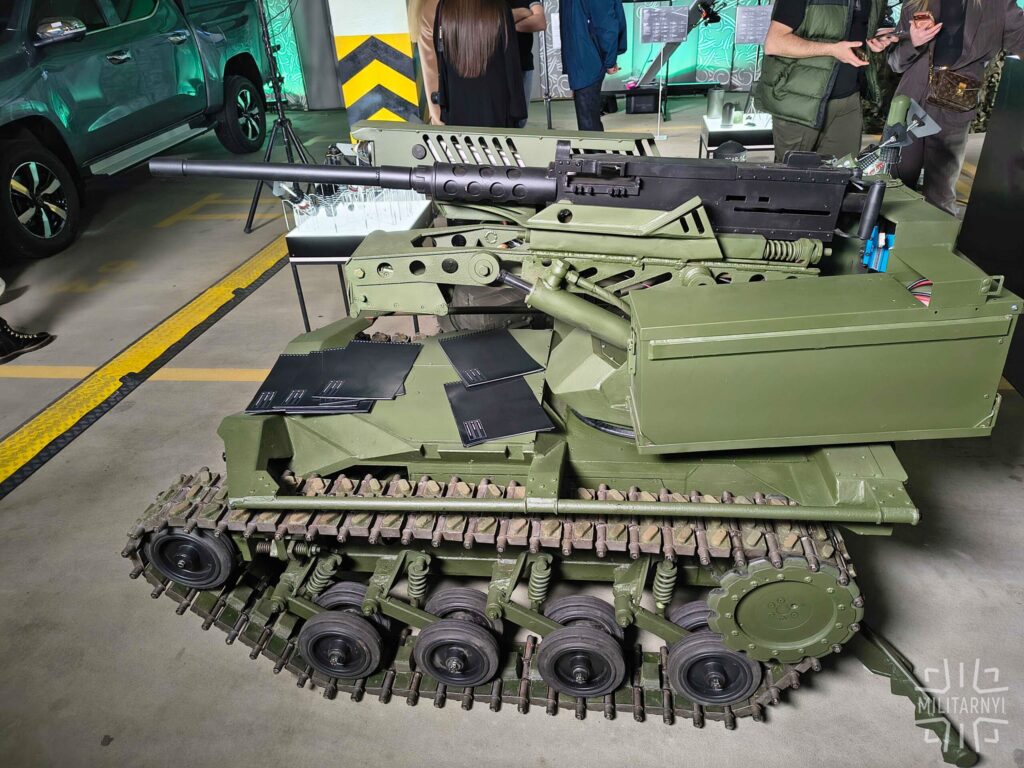
The unmanned ground platform is designed to destroy armored vehicles, fortifications, enemy personnel, and low-speed aerial targets.
The platform already reflects a key trend in modern warfare — the gradual shift toward automated systems operating without direct human presence on the battlefield.
Iron predator enters battlefield and begins hunting without humans
Spider can be equipped with various types of weapons, from heavy machine guns to automatic grenade launchers. Among them are the Browning M2 heavy machine gun, PKT machine gun, AGS-17 grenade launcher, and Mk 19 grenade launcher.
An elevation angle of up to +70 degrees allows it to engage not only ground targets but also elevated targets, including drones, significantly expanding its combat capabilities.
The tracked chassis ensures high mobility, allowing the platform to overcome difficult terrain and autonomously reach designated positions.
Machine holds front line without fatigue and pushes humans out of most dangerous areas
One of Spider’s key characteristics is endurance, with up to 72 hours of operation depending on usage intensity. This allows it to maintain positions or perform missions over extended periods without rotation.
A 360-degree situational awareness system provides full control over the surrounding environment, which is critical for remotely operated platforms.
The current version uses a steel hull. This is an engineering solution that maintains the required weight and size parameters for a future armored modification.
Fiber optics decide who lives and who dies
Spider is controlled via multiple channels — LTE, radio communication, Starlink, or fiber optics. This multi-channel approach increases resilience against interference and electronic warfare systems.
The platform is currently undergoing codification for official deployment within Ukraine’s Defense Forces.
The emergence of such systems highlights a deep transformation of the battlefield, where remote platforms are increasingly taking over functions previously performed by soldiers on the front line.