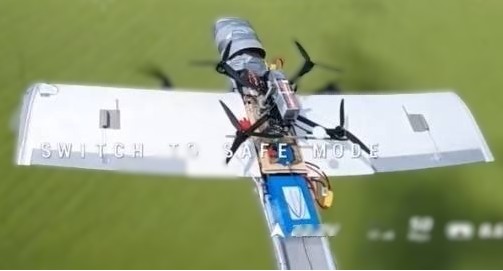
Ukraine reports on a decline in the use of expensive strike UAVs and a shift by Russian forces toward cheaper systems such as the “Molniya” drones, according to Serhii “Flash” Beskrestnov, an advisor to the Minister of Defense.
The Russian military has upgraded Molniya drones, turning them into low-cost reconnaissance and surveillance platforms that are increasingly replacing traditional strike roles.
Radars are being challenged as Molniya drones fly low
The key issue with them, Beskrestnov notes, is low radar visibility due to low-altitude flight and the use of airframe materials, which makes interception by anti-drone systems significantly more difficult.
He also highlights that Molniya’s video link operates via powerful 5–10W transmitters and directional antennas, enabling long-range control and stable communication.
“It would be highly desirable for our manufacturers to more quickly supply the front with video EW systems such as ‘curtains.’ We are working on it,” Flash stated.
Frequency agility becomes main battlefield
Beskrestnov emphasizes that while Ukraine possesses many electronic warfare (EW) systems, there is a critical shortage of precise frequency detection tools.
He warns that simple “broad-spectrum jamming” is no longer effective.
"There are too many frequency options"
He also notes that Russian operators increasingly use pseudo-random frequency hopping (PRFH) across a 300–600 MHz range, making signal suppression significantly more complex.
Beskrestnov concludes that these changes require a fundamental redesign of EW systems, as warfare shifts toward mass deployment of cheap drones combined with advanced adaptive communications.
“With such a bandwidth, the control range decreases, but the difficulty of jamming increases. This must be taken into account when developing new electronic warfare (EW) systems,” Flash emphasized.
The Flash's statements came after an assassination attempt on him by Russian
jet-powered drones.
Jet-powered Shahed drones travel at 300–500 km/h, making them difficult to shoot down. The drones used in this attack were manually controlled. He explained that a Shahed struck his house. He noted that his home was completely destroyed in the attack, and he was "caught" by the blast. The analyst was hospitalized.