Ukraine’s F-16s may have Sniper pods for killing low-flying Shaheds

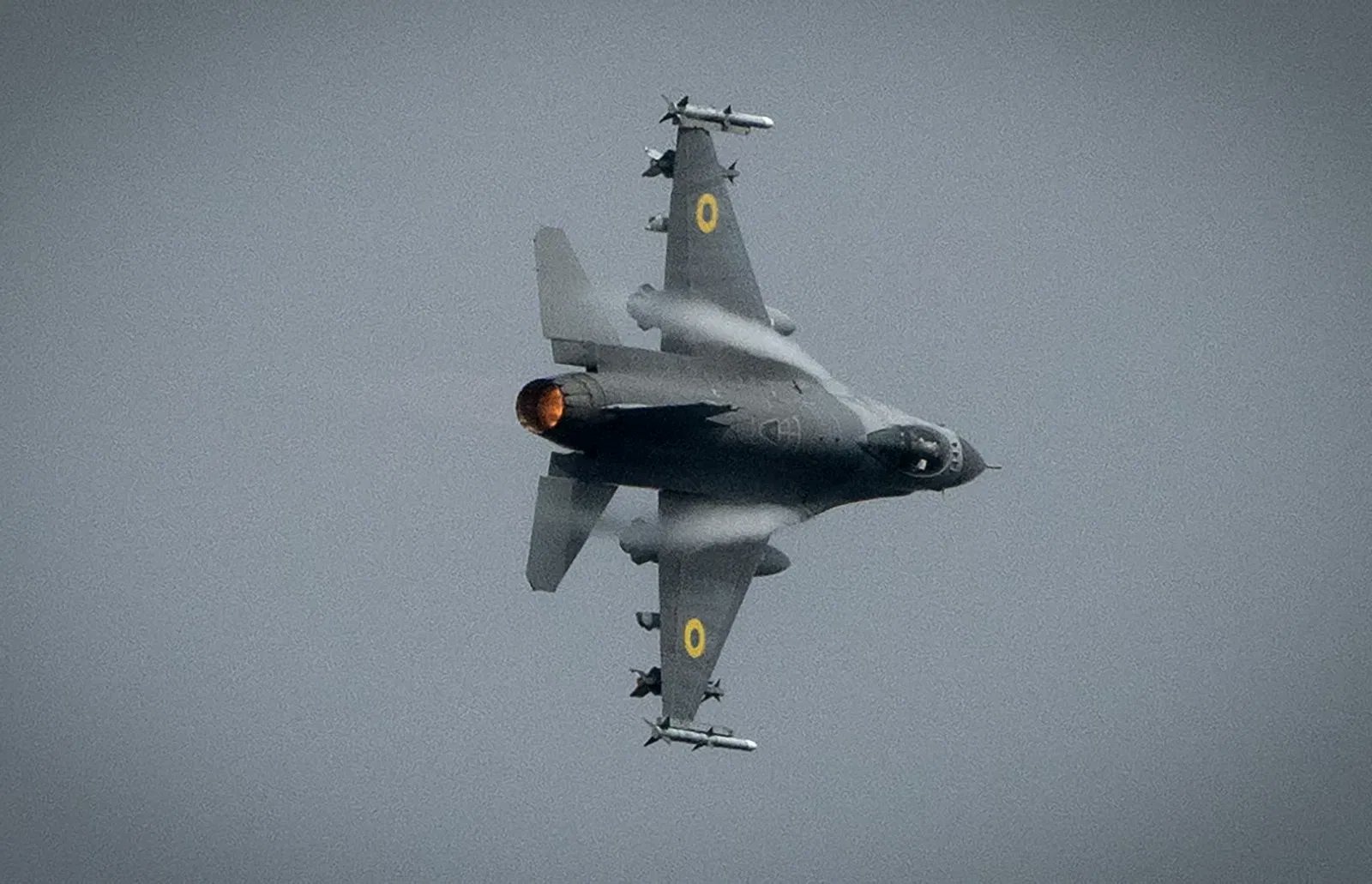
On Thursday, Telegram channel Avia OFN posted a grainy photo of one of the Ukrainian air force's roughly 50 ex-European Lockheed Martin F-16 fighters (out of around 90 pledged) flying with a heavy load of fuel and weapons—and, it seems, an under-nose AN/AAQ-33 Sniper targeting pod.
If confirmed, Sniper pods would significantly boost Ukraine's ability to intercept the thousands of Shaheds Russia launches monthly—using infrared detection that works even when drones fly too low for radar.
The Sniper pod includes high-fidelity daytime and infrared cameras, adding to the standard sensors on an American-designed F-16, including the fighter's nose-mounted APG-66(V)2A radar, various radar-detecting electronic countermeasures, and the pilot's eyes.
The $2 million Sniper or a similar pod is standard equipment on most F-16s, but Ukraine has never acknowledged receiving such pods, either as donations from an ally or via a direct purchase.
To be clear, Avia OFN's photo is not hard proof that Ukrainian F-16s have Snipers. It's too grainy and dark—and shot from a weird angle—to clearly show the Sniper's distinctive tubular shape.
It would make sense for Ukraine to acquire Sniper pods, however. They can help the fighters find and shoot down the Shahed drones that Russia launches at Ukrainian cities and power plants at a rate of thousands per month.
Extra eyes in the sky
The F-16's APG-66(V)2A radar can detect a 200-kg Shahed from tens of kilometers away under the right circumstances. All radars work less well when they're looking down from a high altitude toward a target flying at a lower altitude, as the ground can reflect back the radar waves, obscuring the target's signature in electronic clutter.
Shaheds can fly as low as a few meters off the ground, or as high as thousands of meters. At the lower altitude, they might be more vulnerable to ground-based air defenses, but safer from overhead interception by F-16s or other fighters.
Unless the fighter has a Sniper pod that can spot a Shahed by way of the heat emitted from its propeller or jet engine. As long as the engine is hotter than the ground below, it should show up from kilometers away on a Sniper's infrared camera.
As a bonus, any F-16 pilot using his Sniper as his primary sensor could fly and fight without switching on his radar. That's advisable, as Russian radar receivers can detect Ukrainian radars, pinpointing the locations of airborne F-16s—and exposing them to long-range missile fire.
The Sniper is, in other words, the stealthy way to hunt for Shaheds.
Cheap rockets for cheap drones
And yes, it's apparent the F-16 in Avia OFN's photo was on an anti-Shahed sortie. In addition to possibly carrying a Sniper pod, the fighter was also hauling underwing pods for AGR-20 Advanced Precision Kill Weapon Systems.
The APKWS is a laser-guided rocket weighing 15 kg and ranging as far as 11 km. Packed in pods of seven rockets, the APKWS is ideal for shooting down numerous slow targets in just a few passes. It's also cheap compared to bigger air-to-air missiles that, for anti-Shahed missions, are frankly overkill.
The cost math: rockets vs. missiles
| Weapon system | Unit cost | Per sortie capacity | Cost efficiency |
|---|---|---|---|
| APKWS laser-guided rocket | ~$35,000 | 14 rockets (2 pods) | Cost-effective |
| AIM-9 Sidewinder missile | ~$400,000 | 6 missiles | Overkill |
| Shahed drone (target) | ~$50,000 | — | — |
Why fighters alone can't stop the swarms
Fighters are still inefficient defenses against Shaheds, given that Ukraine might be able to sortie 10 or a dozen F-16s every time Russia attacks, but each attack might involve 500 or 600 Shaheds. A standard F-16 load-out of six AIM-9s would, with a perfect hit rate, bring down just six Shaheds. Fast-firing and inexpensive ground-based air defenses are the best weapons against the drones.
But if you're going to add F-16s to your layered defense against Shaheds, it'd be best to arm them with laser-guided rockets—and equip them with Sniper pods.
Key Sniper pod capabilities
| Feature | Capability | Anti-Shahed advantage |
|---|---|---|
| Infrared camera | Detects engine heat signatures | Spots low-flying drones that evade radar |
| Daytime camera | High-fidelity visual identification | Confirms targets before engagement |
| Passive operation | No radar emissions required | F-16 remains invisible to Russian detection |
| Laser designator | Guides APKWS rockets to target | Enables cheap, precise drone kills |

| Weapon system | Unit cost | Per sortie capacity | Cost efficiency |
|---|---|---|---|
| APKWS laser-guided rocket | ~$35,000 | 14 rockets (2 pods) | Cost-effective |
| AIM-9 Sidewinder missile | ~$400,000 | 6 missiles | Overkill |
| Shahed drone (target) | ~$50,000 | — | — |
| Feature | Capability | Anti-Shahed advantage |
|---|---|---|
| Infrared camera | Detects engine heat signatures | Spots low-flying drones that evade radar |
| Daytime camera | High-fidelity visual identification | Confirms targets before engagement |
| Passive operation | No radar emissions required | F-16 remains invisible to Russian detection |
| Laser designator | Guides APKWS rockets to target | Enables cheap, precise drone kills |