
Ukraine’s $50,000 drone just did what only $500,000 munitions could
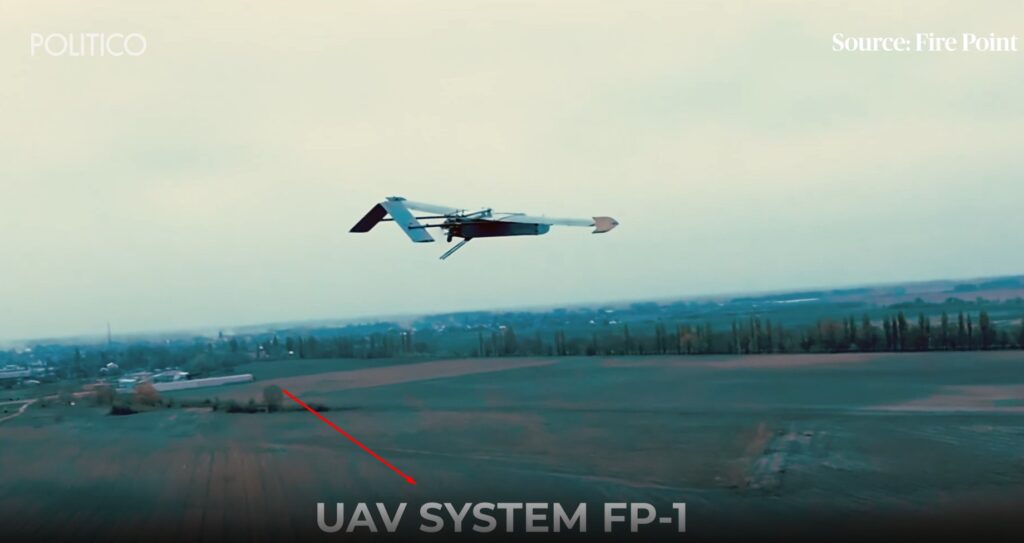

- The upgraded Fire Point FP-1 can reach as far as 3,000 km, according to Zelenskyy—up from 1,000 km
- How Fire Point extended the range is unclear, but it may involve shrinking the warhead
- The new, farther-flying drone struck a refinery deep inside Russia on Saturday
On Saturday, Ukrainian Fire Point FP-1 one-way attack drones motored more than 2,000 km to blast an oil refinery in Tyumen, in central Russia. The result was, according to Ukrainian President Volodymyr Zelenskyy, "an effective strike" on a refinery that processes as many as 9 million tons of crude a year.
The potential impact on the refinery and Russia's wider oil industry is less notable than the sheer distance the propeller-drive FP-1s traveled, however. The Saturday raid was apparently the combat debut of a new, longer-ranged FP-1 model that had made its first public appearance just a few days earlier.
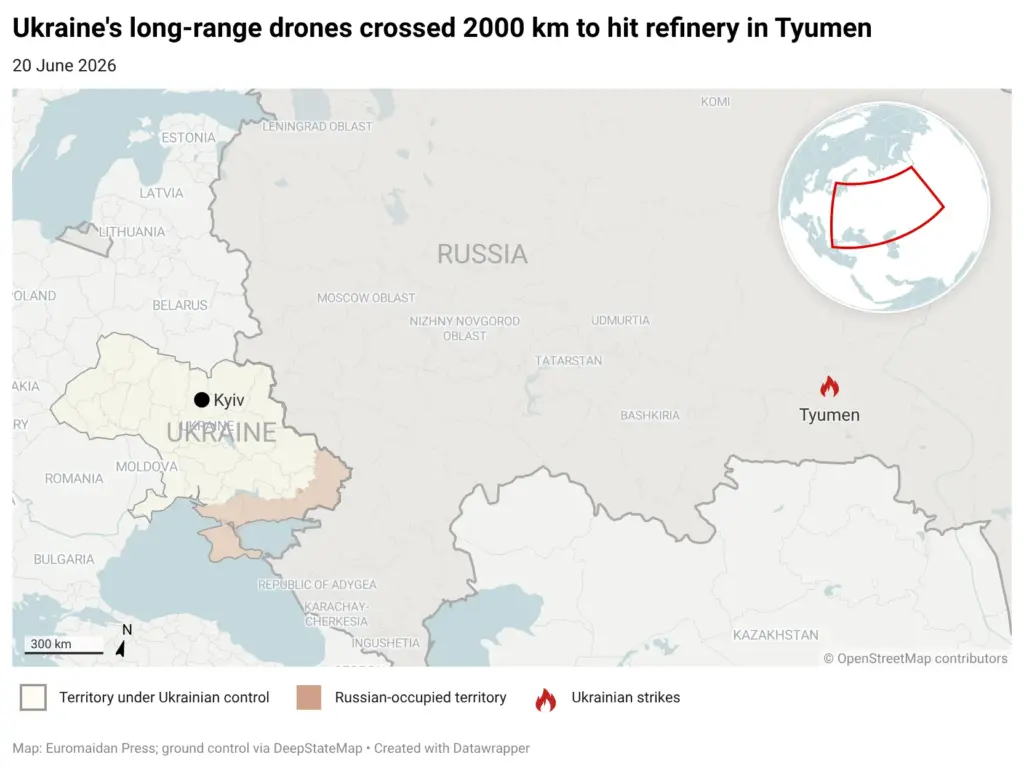
"The job was carried out by the new, upgraded FP drones that can now reach targets at distances of 3,000 kilometers," Zelenskyy wrote. "I am grateful to the Fire Point engineers."
Drone- and missile-maker Fire Point has been steadily enhancing the FP-1 and its shorter-range, heavier-warhead FP-2 variant ever since selling the first copies to Ukrainian forces back in 2024. Priced to move at as little as $50,000 per drone and designed for mass production on the scale of hundreds of drones a day, the FP-1/2 doesn't just lend mass to the Ukrainian deep strike campaign. It also lends the campaign some of its most advanced capabilities.
The only other Ukrainian munitions that routinely range 2,000 km or farther are Fire Point's FP-5 cruise missile and a couple types of sport plane that Ukrainian forces have modified into autonomous one-way attack drones. Where FP-1/2s are cheap and numerous, FP-5s and sport plane drones are expensive and rare, some costing as much as $500,000 apiece.
The FP-1/2 has steadily evolved. The first iteration of the FP-1 ranged 1,000 km under inertial and satellite navigation but suffered from a small warhead weighing just 60 kg. The range was decent for 2024 but the warhead was totally inadequate. An FP-1 could strike a refinery or some other toughly built target without inflicting much damage.
Tradeoffs
Fire Point and other Ukrainian drone-makers had made the deliberate choice to prioritize fuel over explosives. "Given the long distances these drones must travel, increasing their warhead size would require adjustments to weight, fuel capacity and overall design," Ukrainian analysis group Frontelligence Insight explained.
But Ukrainian developers kept working. The advent of the FP-2 last year addressed the firepower problem. Trading fuel capacity for a bigger warhead, Fire Point boosted the FP-2's warhead to 100 kg. Range shrank to 200 km, however, restricting the big-boom FP-2 to medium-range strikes mostly over occupied Ukraine rather than inside Russia.
Fire Point's next innovation, this spring, was to redesign both the FP-1 and FP-2 to increase internal capacity. Engineers installed fuel tanks in the drones' wings, freeing up space inside both types' fuselages for bigger warheads. This second generation of FP-1 and FP-2, which also boasted jam-proof terrain-matching navigation, hit harder with a 105-kg warhead (in the case of the FP-1), and a 158-kg warhead (in the case of the FP-2).
 Fire Point in Paris spoke about the updated FP-1/2 drones with increased range
 200-kilogram warhead on the FP-2. The drone's flight range with it is 370 kilometers. The update will increase the flight range of the "middle strike" to 700 km while maintaining the… pic.twitter.com/6crWaGKBsb— MAKS 26
 (@Maks_NAFO_FELLA) June 18, 2026
The third generation appeared this summer. Somehow, Fire Point extended the FP-1's range from 1,000 km to a reported 3,000 km. Perhaps by once again shrinking the warhead and stuffing both the wing and fuselage with fuel. Drone design represents a constant tradeoff between payload and range, and Fire Point is making those trades in order to alternately extend the reach and destructive power of the firm's deep strike drones.
Given the tradeoff, a single FP-1 that flies 2,000 km to strike a refinery probably doesn't inflict much damage all by itself. But the steady ramp-up in drone production at Fire Point and other manufacturers means that Ukraine can sortie dozens or even hundreds of drones at a time.
Now that Ukrainian forces can hold the Tyumen refinery at risk from 2,000 km away, they could strike with more and more drones at a time. Inflicting with repeated small strikes the same damage that fewer, more explosive drones would inflict with less frequent strikes.
It's telling that, in describing the Saturday raid on Tyumen, Zelenskyy referred to "upgraded FP drones," not "an upgraded FP drone."
Ukraine’s newest drones don’t need Starlink. Russia spends $1.5 million to jam it anyway.