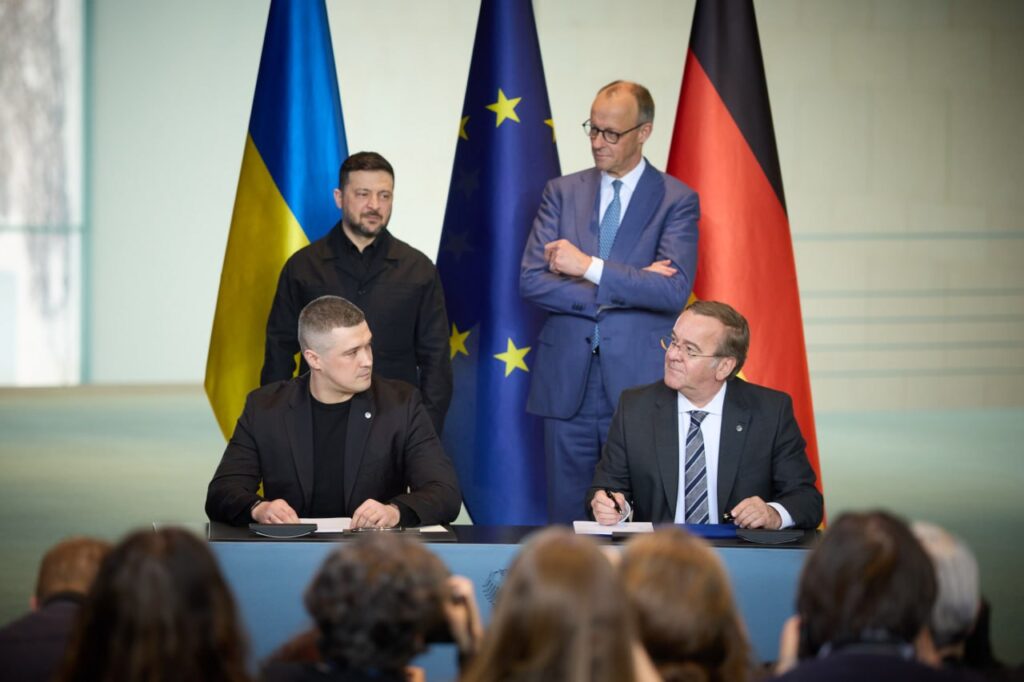
Ukraine is opening access to wartime data by launching a unique defense project together with Germany. Kyiv and Berlin have signed their first agreement on defense data exchange, enabling joint analysis of combat experience and the development of military technologies based on it, according to Ukraine’s Minister of Defense Mykhailo Fedorov.
Germany will provide €11.5 billion in military aid to Ukraine this year, which accounts for nearly 35% of all international military assistance to Kyiv.
On 14 April, Fedorov and Germany’s Defense Minister, Boris Pistorius, signed the memorandum, with President Volodymyr Zelenskyy and German Chancellor Friedrich Merz in attendance.
Frontline data becomes new currency of war
Under the agreement, both sides will analyze the use of German systems — including PzH 2000, RCH 155, and IRIS-T based on real battlefield data.
This is expected to increase operational efficiency and refine battlefield tactics.
Artificial intelligence is shaped by real combat
Ukraine will also provide partners with access to unique combat datasets for training and improving AI models and analytical systems.
This represents a breakthrough defense AI initiative, grounded not in simulations but in live war experience.
Partners will gain access to the DELTA system and other digital platforms already in use on the battlefield.
Cooperation shifts into realm of algorithms
“Today, Volodymyr Zelenskyy proposed an important bilateral drone deal with Germany, and our teams are already working on the next steps,” Fedorov says.
In addition, agreements were reached on the supply of weapons, including MIM-104 Patriot PAC-2 missiles and launchers for the IRIS-T systems, which Ukraine will receive in the coming years.
This is expected to significantly strengthen air defense and enhance the protection of Ukraine’s skies.
Earlier, Fedorov announced that Belgium and Spain allocated €1 billion each in defense assistance for Ukraine. The funding will be directed toward strengthening air defense, developing drone capabilities, and supporting the “Czech initiative” to supply the front line with long-range artillery.