Trump admin asks DC appeals court to block Boasberg contempt inquiry, DOJ testimony
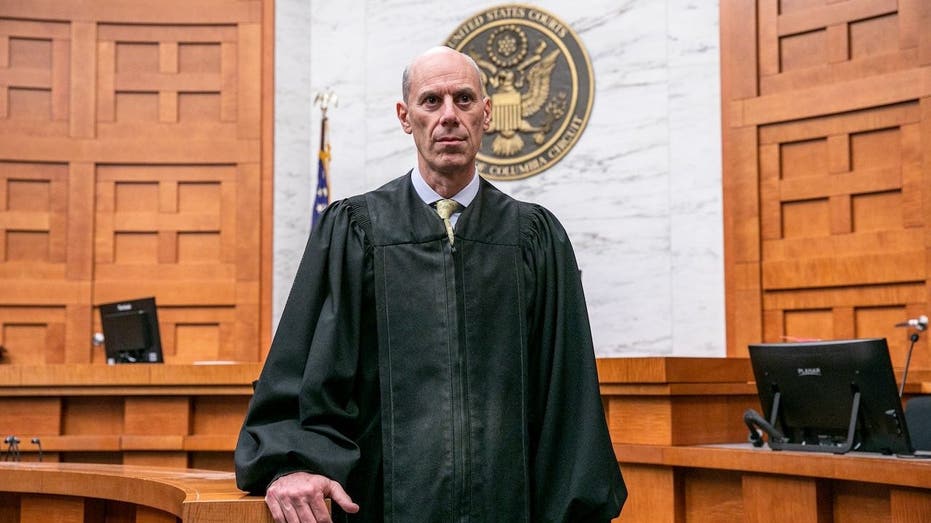
Lawyers for the Trump administration asked a federal appeals court Friday to block U.S. District Judge James Boasberg's newly revived contempt inquiry into its Alien Enemies Act deportations, arguing in a new filing that the appeals court should intervene to block the contempt inquiry altogether, or at the very least, block the scheduled testimony of two DOJ officials scheduled for next week.
The writ of mandamus, filed with the U.S. Appeals Court for the D.C. Circuit, seeks to head off the contempt inquiry altogether, which Justice Department lawyers described as an "idiosyncratic and misguided inquiry" outside the district court's jurisdiction.
Short of terminating the proceedings, they asked the court to bar testimony from two current and former officials ordered to appear for questioning next week.
Lawyers for the Trump administration also requested that the appeals court order the case be reassigned from Boasberg, whom they accused of being "engaged in a pattern of retaliation and harassment" in his consideration of the case.
"This latest order portends a circus that threatens the separation of powers and the attorney-client privilege alike," they argued Friday. "This long-running saga never should have begun; should not have continued at all after this Court’s last intervention; and certainly should not be allowed to escalate into the unseemly and unnecessary interbranch conflict that it now imminently portends."
Lawyers for the Trump administration asked the appeals court to intervene by 5 p.m. Friday.
The contempt inquiry had been expected to bring to the fore long-simmering tension between the Trump administration and the chief judge for the U.S. District Court in Washington, D.C., who sparked Trump's ire earlier this year after he attempted to temporarily block the administration's use of the Alien Enemies Act to deport hundreds of Venezuelan migrants to El Salvador in March.
While the appeal is new, the arguments are not. Justice Department lawyers echoed many of the claims in a separate court filing earlier this week. "At the outset, the Court’s inquiry exceeds its authority and is now intruding on the prerogatives of a co-equal branch," they told Judge Boasberg, adding that criminal contempt falls within the executive branch’s power.
"Criminal contempt is a criminal offense, and the investigation and prosecution of crimes is [a] core executive power reserved to the Executive Branch," they added.
Boasberg this week requested testimony from two current and former Justice Department officials who played a key role in the Trump administration's use of the 18th century wartime law to quickly deport the migrants to El Salvador in March, despite his temporary restraining order and subsequent oral order that attempted to block — for 14 days — the administration's use of the Alien Enemies Act to immediately deport the migrants.
He is now weighing whether senior Trump officials willfully defied that order, and to wit, had ordered Drew Ensign, the Justice Department's deputy assistant attorney general, to appear in court Monday for questioning and for cross-examination from lawyers representing the class of deported Venezuelan migrants.
TRUMP ADMINISTRATION ASKS SUPREME COURT TO REVIEW EL SALVADOR DEPORTATION FLIGHT CASE
He also ordered testimony and cross-examination the following day from former Justice Department lawyer Erez Reuveni, who since parting ways with the Justice Department has publicly accused the administration of ignoring court orders — including in this case.
It is unclear what steps the appeals court will take to intervene, if any.
"The Court thus believes that it is necessary to hear witness testimony to better understand the basis of the decision to transfer the deportees out of United States custody in the context of the hearing on March 15, 2025," Boasberg wrote in scheduling the appearances.
"The events surrounding this decision should shed light on this question," he said.
The inquiry was revived after the D.C. Circuit, sitting en banc, vacated an earlier ruling and returned the matter to Boasberg. New details about the government’s handling of the March flights have already emerged, with additional disclosures expected in the coming days.
Still, court filings revealed that the Trump administration plans to fight those efforts at every turn.
"If the Court does proceed with testimony, it should grant a protective order with respect to privileged information or provide Defendants with an opportunity to seek appellate relief in advance of any testimony; and the Court should also limit the scope of the testimony and preclude Plaintiffs from participating," they told Boasberg.
TRUMP FOE BOASBERG ORDERS DOJ TO DETAIL STATUS OF CECOT MIGRANTS SENT TO VENEZUELA
Last month, DOJ officials identified DHS Secretary Kristi Noem as the official who authorized the transfer of the Venezuelan migrants after being briefed on Boasberg’s emergency order by lawyers for the Justice Department and acting general counsel for DHS.
Boasberg said earlier this week that it would be "premature" to refer anyone for prosecution under the revived contempt probe, and declined to immediately compel testimony from Noem at this stage in the process.
Noem said in a declaration of her own that she made that call based on legal advice from lawyers for the Justice Department, as well as the acting general counsel for DHS.
The fresh action on the contempt issue is almost certain to spark the ire of some Republicans in Congress and from Trump himself, who has repeatedly excoriated Boasberg as an "activist judge" for his role in the Alien Enemies Act case and resulting inquiry.
Boasberg, for his part, has appeared unfazed.
"This has been sitting for a long time," Boasberg said late last month of the contempt inquiry, "and I believe justice requires me to move promptly on this."
The government, he added, "can assist me to whatever degree it wishes."