
Transcript: Trump Press Sec Goes Full Cult Defending New Racist Tirade
The following is a lightly edited transcript of the December 8 episode of the Daily Blast podcast. Listen to it here.
Greg Sargent: This is The Daily Blast from The New Republic, produced and presented by the DSR Network. I’m your host, Greg Sargent.
President Donald Trump has now set his sights on Somali immigrants. He’s been ranting furiously about them, calling them garbage, and saying he wants them all to get out of our country. And he’s even talking about stripping citizenship from immigrants in order to remove them. White House press secretary Karoline Leavitt reacted to this with obsequious praise, calling it “epic.” We thought this was a telling moment. The Trump cult has gotten so out of control that his propagandists now go out of their way to deliberately highlight his most racist and disgusting moments, and pump those up into moments of heroism and triumph. Meanwhile, almost no Republicans had anything critical to say about any of this. In fact, JD Vance pounded the table in agreement with Trump on Somalis. How far is this madness going to get? Today we’re talking about all this with Vedant Patel, a former State Department official who worked on immigration issues under Joe Biden. Vedant, good to have you on, man.
Vedant Patel: Really good to be with you. Thanks for having me.
Sargent: So let’s quickly run through what Trump’s been saying about Somalis. He said, “They contribute nothing. I don’t want them in our country.” He said, “Your country stinks.” He said, “We’re taking garbage into our country.” Meaning Somalis. He attacked Congresswoman Ilhan Omar as garbage, in fact. Vedant, that is naked bigotry coming straight from the president of the United States. Now, we’ve heard versions of this for years, but it almost seems like a new level of fury and hysteria. What’s your response to all this?
Patel: I want to say that I wish I were surprised, but truly, Greg, I mean, this is a playbook out of the president’s first administration. I mean, I think you recall that there was a really poignant moment in which President Trump was saying that he didn’t want immigrants from a certain, fill-in-the-blanks, swear word–types of countries. This is the exact playbook that we’ve seen before of dividing this country, targeting immigrant communities. It’s despicable.
Sargent: So just to clarify what Vedant’s talking about there is Trump’s infamous comment back during his first term that he hates people from “shithole countries,” something to that effect. I would point out, though, that that was actually a private comment that was reported according to sources. Now, Trump said all this stuff about Somalis in public, directly to cameras with a whole bunch of reporters watching—in fact, at a Cabinet meeting with all of his sycophantic, propagandistic officials all around him. I think that’s a new level. What do you think?
Patel: I think certainly we’re seeing that in this second Trump administration, things are increasingly heightened, and they are taking not just their rhetoric but their policy actions to a whole new level.
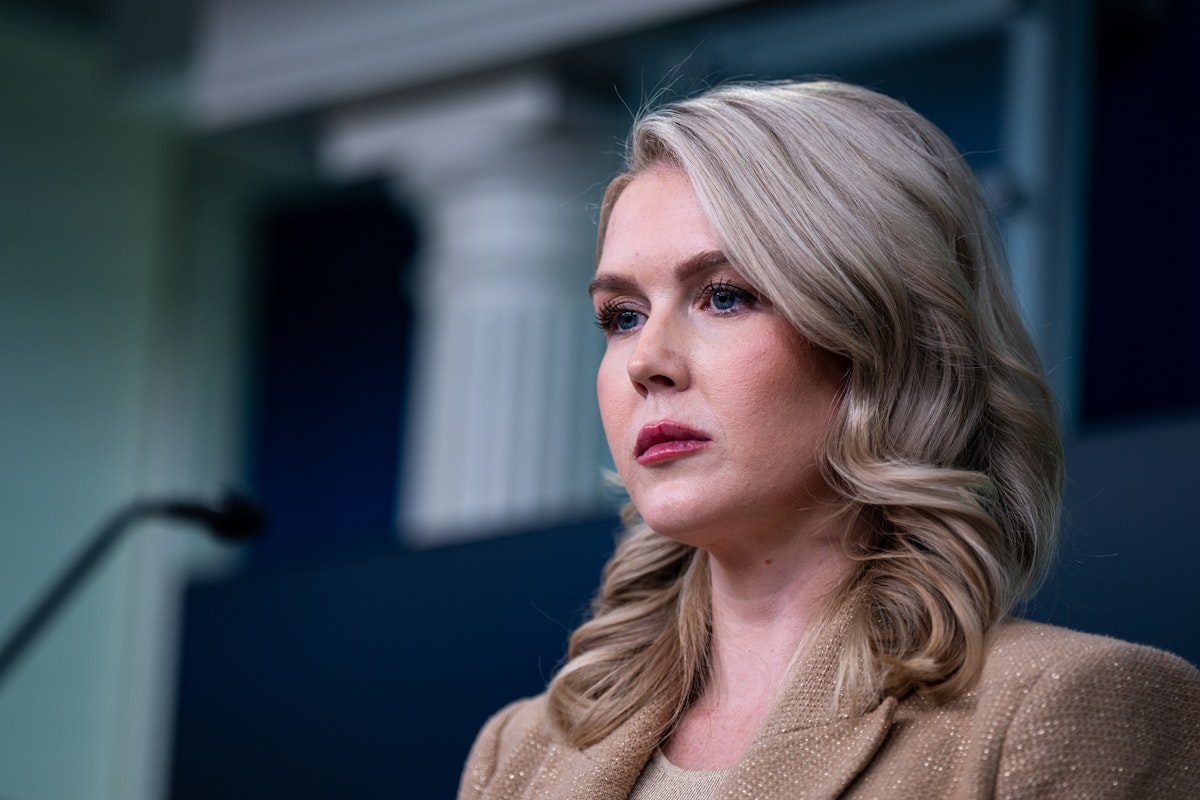
Sargent: They certainly are. Let’s bring in White House press secretary Karoline Leavitt on this. She put out a statement about Trump’s Cabinet meeting, at which she also appeared to fall asleep, by the way. She said this:
“This epic moment put an exclamation point on President Trump’s ninth Cabinet meeting of his second term, all of which have been entirely open to the press for the whole world to see.”
Now, she was talking about what Trump said about Somalis. That’s the epic moment she’s referring to. “Epic moment,” exclamation point! The entire world is watching. Vedant, I think this is notable. She went out of her way to hail Trump’s racist outburst precisely because he’s been criticized widely for it. The cultishness is off the charts, isn’t it?
Patel: I certainly would say so. Let’s put the policy aside just for a second. Let’s put the Somali piece aside for just a moment. I worked in the press office under President Biden. That is not the way you are supposed to be doing media relations. Let’s remember that these are spokespeople that should be working. Yes, they work for a president, but really, ultimately, their job is to try to inform the American public, be good arbiters of truth and good engagers with journalists, help answer questions, help inform coverage and stories and TV packages and things of that nature. It is not to be sycophants and just be partisan hacks with a taxpayer dime.
Sargent: Can you talk a little bit more about that? Like, you worked in the State Department, you’ve got reporters talking to you about policy issues, you’ve got them asking for clarification of presidential comments. In this case, though, this was naked racism, really disgusting bigotry, smearing an enormous population inside the United States, which includes a whole lot of citizens. I think ABC News said 73 percent of Somali immigrants are naturalized citizens, if I’m right. This is just really unthinkably awful behavior on Karoline Leavitt’s part, to go out of her way to call this something like a world-historical moment, don’t you think?
Patel: I would say yes, but I mean, this is par for the course with the Trump administration, right? And I think it is what seems to be expected of his senior officials is praise and just flattery when it comes to anything he says. Look, again, putting the policy aside for just a moment. I don’t think there was a single instance in the Biden administration when I characterized what the president was doing or what Secretary Blinken was doing as “epic.” I don’t think that was ever a word that I used because that is not the job. The job is to try to answer questions, convey what’s going on, help inform as it relates to policy and policy decisions and decision-making and thinking and strategy, as it relates to trying to govern this country, not flattery and praise that really isn’t rooted in reality.
Sargent: They really do not understand themselves as being public servants in any sense, I think. Now, let’s talk about what is happening with Somalis. We’ve had some reporting that ICE is now pretty active up in Minnesota, where there’s a large Somali population. We’re getting reports of people getting pulled over, asked for their passports, asked for their papers. I think this looks like it’s also targeting some citizens as well. What do you know about what’s going on up there?
Patel: So look, this seems to be in line with what we have seen happen in other major metropolitan areas where you’ve seen really increased ICE action target individuals. It’s unclear what metric the Department of Homeland Security is using in terms of the types of folks they’re looking at, the types of folks that they’re arresting, and so on and so forth. There’s a lot of questions.
But I think you kind of hit the nail on the head when you said that more than 70 percent of Somalis are American citizens. The other thing to keep in mind is that there’s also a significant population of Somalis who are in this country under what we call Temporary Protected Status, in which they’re in this country because the conditions in Somalia are as such that it would be far worse, far more dangerous, far more burdensome to deport them back to Somalia because of the conditions there. And that’s something we have to keep in mind as well.
But more than anything—more than just Somalis—this is another blatant attack on immigrant communities. Obviously, any administration, Democrat or Republican, should be enforcing the law. We should be following our immigration laws. People in this country should be abiding by their immigration laws. But I think this blatant targeting without any clear proof or logic or even theory of what it is, is deeply concerning. Look, if people are violent criminals, if they’re offenders, if they are a threat to this country, certainly, I think those kinds of folks should be removed. But I think this just blatant washing of an entire community, of an entire population of folks with one broad brushstroke is deeply troubling and problematic.
Sargent: Well, you brought up Temporary Protected Status, which is often called TPS. Can you just give us a really brief overview of what that is? I want to point out for people that Trump has actually ended TPS for a number of different groups. This is something that is given to people who are facing some of the very worst conditions imaginable on the planet. Can you talk about what TPS is?
Patel: Yeah, Temporary Protected Status—essentially, it’s what it sounds like. People who are in the United States from a particular country, they are protected from removal and returning back to their home country. There are a number of countries, historically, in which the United States has had this TPS program. Somalia is an example. Haiti is another country in which, historically, there’s been a TPS program. Another one is Venezuela, and so on and so forth. And basically, when you designate somebody under a TPS, under Temporary Protected Status, the secretary of Homeland Security will say that any person of country of origin, of fill-in-the-blank country, if they’ve been in the United States since X date because of the conditions on the ground in that country, they are protected from removal from the United States because the conditions in those countries are so—often they have to deal with just danger, threat, things like that, human rights conditions, but also impact from natural disasters and things like that. Just whatever all these conditions that make it such that conditions on the ground in this particular country make it so that they should not be returned there. And we’ve had this, it’s a bipartisan program that has existed in this country for many, many years. And there have been a lot of countries in which we’ve had TPS designation for, historically.
Sargent: Trump let out this really crazed, vicious rant on Truth Social that I want to get into a little bit. He said, “I will permanently pause migration from all Third World countries to allow the U.S. system to fully recover.” He said, “Only reverse migration can fully cure this situation.” And he said that he’s going to “denaturalize migrants who undermine domestic tranquility.” Here he called it reverse migration, but Trump himself has actually endorsed remigration on a number of occasions. And remigration is something that the far right envisions almost like a mass removal operation, which is meant to ethnically reengineer polities. Can you talk a little bit about that?
Patel: I think the concept of remigration, as I assume that, you know, President Trump and Stephen Miller and others think about it, is basically you denaturalize a certain [subset] of folks, and then that basically means that they then no longer have grounds to be in the United States and thus can be removed. And it’s clear from just the commentary and rhetoric that is coming from this administration that there seems to be a targeting of immigrants and migrants who, candidly, are people of color and come from countries that are of a particular background.
Sargent: Yeah, I’ll say it’s very focused on people of color. In fact, right now, pretty much the only refugees we’re letting into the country are Afrikaners, who are white. Now, let’s talk a little bit about his denaturalization threat. What is that? What does that entail, like, logistically and bureaucratically? And how realistic a threat is it?
Patel: So I’m not a legal expert and certainly don’t want to try to get too far into the head of this administration and how this would work. And so how they would actually execute on a policy like this, I have no idea. But I think my broad takeaway is that we should take everything that this administration says at face value. I think the biggest takeaway from the first administration is that we should not just chalk things up to just rhetoric. It seems like when they say something that they have a desire or an intention to act on it. And so how they plan on going about this is unclear, but it seems to be a priority. This is something that they have said previously, something that the president and Stephen Miller have talked about openly. And I think it’s something increasingly of concern.
You have to remember, is that most people who are American citizens, actually anybody who’s an American citizen, has gone through a lengthy process if they are naturalized, right? If you’re an American citizen and you were not necessarily born on U.S. soil and not born to an American citizen, you have gone through a fairly lengthy process to be naturalized in this country. As part of that process, you’ve had interviews, you’ve had background checks, you’ve been vetted, so on and so forth. It’s a lengthy, oftentimes multiyear, multistep process. And so now to say that you are going to denaturalize individuals who have gone through that process, it’s incredibly alarming. I am sure that there are some legal and constitutional questions that absolutely need to be raised if they go about this.
Sargent: Well, we should point out that denaturalization is actually very hard to pull off as well, is it not?
Patel: I would say so. I mean, I truly can’t wrap my hand around logistically how they would do that in a way that is that actually comports with the law.
Sargent: Just to close out, I think there’s one ominous thing we should point to here: During Trump’s first run for office, Republicans would condemn this sort of thing when Trump did it. In fact, I recall Paul Ryan criticizing Trump’s anti-Muslim bigotry at one point. But now, when he goes out there again at a Cabinet meeting in front of 50 cameras and the whole world watching, as Karoline Leavitt put it, almost no Republicans said anything. Former Minnesota Governor Tim Pawlenty, who’s a Republican, did say something. He said there is a danger in “stigmatizing any ethnic group, any racial group, any religious group.” He added, “I don’t think we want to start having those kinds of words applied to whole groups.” Glad he said that, Vedant, but apparently that’s too much for Republicans to say now, right?
Patel: I mean, look, let’s just be honest. I think no one is holding their breath that the members of President Trump’s own Cabinet were going to say anything in response to comments like that—at least I certainly was not. It is clear from the get-go that this is a president, it’s an administration, that values and candidly monetizes praise, flattery, things like that. But I think one of the biggest takeaways from the first Trump administration is that when Republicans spoke out, when they said something, when they didn’t agree with the president, they either realized that they were going to get a primary from the right, or they saw the writing on the wall, they were going to have their own internal domestic political challenges, either in their state or their congressional district, and then ultimately left public service. A lot of examples like that. And you have to assume that Republicans across the spectrum are grappling with that reality when they choose or choose not to speak up, or at least comment on what this administration is doing.
Sargent: Well, speaking of which, just to circle back to Karoline Leavitt, she called this an epic moment that put an exclamation point on Trump’s Cabinet meeting, the whole world watching, et cetera, et cetera. You know, this sort of is of a piece with the broader thing that they’re doing to the press office. And this is something I’d like you to comment on as someone who’s worked as part of a White House or administration press operation. They’ve emptied out the White House press corps of serious reporters, at least to some degree. And they’ve put in a bunch of reporters in quotes who are functionally propagandists. They simply don’t recognize any obligation of any kind to treat the press as an important institution as part of our democracy. Is that overstating it, or am I right?
Patel: I think that’s right. I think that they have, I think through a fallacy, have tried to sell this snake oil idea that the inclusion of some of these other outlets is somehow more representative of the types of news and the types of media and types of outlets that more and more American people turn to. Now, look, absolutely we need to always, every day, be thinking about ways when thinking about the White House press briefing or the State Department press briefing. How can we get more outlets into the fold? How can we reach more audiences? How can we talk to more American people?
We absolutely need to be thinking about that. But I think that there is an institutionality to how these briefings have historically been conducted. Honestly, I think that they have worked in terms of the makeup of the press briefing room, how those things have operated. And I think the biggest takeaway is that actually, in a well-functioning White House, these are not decisions that the White House press office or the administration makes. There is a reason you have a White House Correspondents’ Association to figure things out like where the seats are in the briefing room, who travels with the president on what trip. There’s only X amount of press seats on Air Force One, right? And so you don’t want to be making those decisions as a government official, as someone who’s a spokesperson for—those are not decisions you want to be involved in, right?
It’s good that you have a thing, an entity like the Correspondents’ Association to figure that out because, you let that decision be made among the journalists themselves. I think that’s a good thing. I think when that system was in place, it worked incredibly well, and we should try to go back to that. Now, simultaneously, we absolutely should be thinking through ways in which new media can have a seat at the table and they can participate in the briefing room and other kinds of new outlets that the American people are increasingly turning to on a day-to-day basis.
Sargent: And Karoline Leavitt is really just not seriously trying to envision a sort of, I guess, reformed White House press operation in any meaningful sense. It’s just pure propaganda at this point, no?
Patel: Yeah, I don’t think that they are actually fundamentally intellectually interested in having the briefing widen the audience and to get more types of different outlets engaged. I think they just want to try to control who’s in the room, who’s in the Oval Office, who’s in sprays, who’s on the trips, and really try and just reward outlets that are favorable to the Trump administration and ask questions that are, again, flattering, that are praising this administration, as opposed to asking tough, realistic questions rooted in public policy, asking how some of these things are going to be conducted, whether they’re lawful or not, whether they’re constitutional.
Sargent: One hundred percent. Those who actually do real journalism on the Trump administration get punished, they get castigated publicly, they get humiliated. And that’s really Karoline Leavitt’s main project. Vedant Patel, thank you so much for coming on with us. Great stuff, man.
Patel: Really good to be with you and looking forward to next time.


