
Starobilsk incident highlights Ukrainian concerns over civilian risk in deep strikes and limits of wartime verification in occupied areas
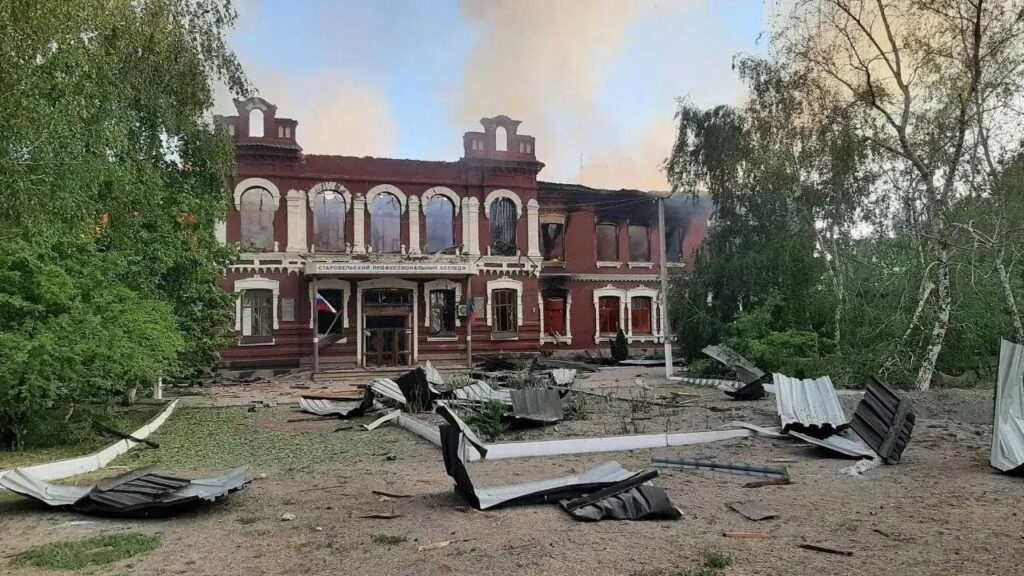

Reports of a Ukrainian strike in occupied Starobilsk, Luhansk Oblast, on 22 May, have prompted conflicting accounts about the target and reported civilian casualties, with Ukraine describing a strike on Russian military infrastructure and Russian occupation authorities saying a college dormitory was hit.
The incident has become part of a broader discussion inside Ukraine about long-range strikes, verification limits in occupied territory, and how civilian harm claims are assessed when access is restricted and narratives are controlled by Russia.
Ukraine’s General Staff said its forces carried out strikes in the Starobilsk area targeting a command position linked to Russia’s elite “Rubicon” drone unit, which operates drones used in attacks against Ukrainian military positions and civilian infrastructure.
Russian occupation authorities said a college dormitory was hit in the same night and reported that more than 20 people were killed, most of them students.
The relationship between the competing accounts has not been independently verified. Available information does not establish whether the reported military target was located inside, adjacent to, or separate from the buildings described as a dormitory by Russian authorities.
Ukrainian media reviewed online traces of reported victims
An investigation by Ukrainian outlet Realna Hazeta reviewed social media profiles, memorial posts, and statements from relatives and classmates, suggesting that some of the reported dead were students.
The reporting cross-referenced names published by Russian sources with publicly available online profiles and commemoration activity, finding that some of the individuals correspond to students at the Starobilsk Pedagogical College.
These online materials can help corroborate identity and community recognition, but they do not independently confirm the full circumstances of death or the exact conditions inside the damaged buildings.
Access to Starobilsk remains tightly controlled by Russian occupation authorities, limiting independent verification on the ground. Reporting from the area is constrained by restricted access, curated site visits, and reliance on information released by occupying structures.
Reuters reported from Starobilsk on 24 May on a media facility trip organised by the Russia’s Ministry of Foreign Affairs, but said they were “not able to independently verify what happened.”
Russian messaging and controlled access reported
Russian authorities and occupation-linked channels quickly shaped the aftermath of the Starobilsk strike through coordinated messaging and tightly managed media access, according to Realna Hazeta.
The reporting says official narratives emphasized civilian casualties and framed the incident within calls for retaliation, alongside organised public mourning events in Russia.
The investigation also notes the use of selectively released footage and repeated references to victims as “children,” as well as closely supervised visits for foreign correspondents, which limited independent verification of conditions on the ground.
Access restrictions limit independent verification
Ukraine has not disputed that military operations took place in the Starobilsk area on that day but maintains that its forces target Russian military infrastructure in line with international humanitarian law.
It has accused Russian authorities of shaping narratives around the aftermath for propaganda purposes, saying that information released from occupied Starobilsk is being selectively presented and amplified to support broader wartime messaging rather than provide a complete or independently verifiable account of what occurred on the ground.
These claims from Russian occupation authorities are viewed in the context of a documented pattern since 2014 in which similar accusations of Ukrainian strikes on civilian areas in occupied Donbas were repeatedly made without supporting evidence and were not corroborated by independent investigations or verifiable reporting.
Unintentional civilian harm cannot be excluded
At the same time, Ukrainian journalists stress that skepticism about source reliability does not negate the possibility of civilian casualties.
Ukrainian media workers and researchers have also cautioned against assigning combatant roles to the dead without evidence, warning that such narratives echo dehumanization patterns used in Russian information campaigns around Ukrainian civilian casualties during the war.
Journalist Nataliya Gumenyuk, with Ukrainian outlet Hromadske, said the case reflects the difficulty of distinguishing between intended military targets, intelligence limitations, and unintended civilian harm in long-range operations conducted under restricted visibility.
She noted that as Ukraine expands its ability to strike deeper into occupied territory, the likelihood of civilian exposure to military-targeted operations may increase even when civilian infrastructure is not the intended objective.
For those involved in documenting war crimes, she said, it is evident that Ukraine has a “deliberate state policy of conducting warfare within international humanitarian law.”
Gumenyuk said personnel involved in drone operations are aware of the risks of civilian harm, adding that “no one wants to be responsible for the death of civilians.”
She described the Starobilsk case as a potential moment of operational learning that may influence how targeting is assessed in the future.
She also argued that internal scrutiny and public discussion of such incidents are part of maintaining accountability under international humanitarian law, particularly as operational reach expands.
She suggested that any operational adjustments or intelligence refinements arising from such cases would likely occur internally rather than being publicly disclosed, due to the sensitive military nature of the issue.
Russian narratives aimed at occupied population control
Andrii Dikhtiarenko, editor at Realna Hazeta, said reporting on the case is necessary to counter both Russian propaganda framing and narratives that assign combatant roles to victims in occupied areas without evidence.
He added that the students killed in Starobilsk were “victims of a war Russia started against Ukraine.”
He also argued that Russian authorities benefit from using such incidents to deepen divisions between Ukrainians in government-controlled areas and those living under occupation, noting that Starobilsk had previously seen pro-Ukrainian demonstrations after the 2022 occupation.
He suggested that Russian information responses to the incident were likely aimed at reinforcing control over public sentiment in the occupied city.
The Starobilsk events have become part of a broader discussion in Ukraine about long-range warfare, information reliability, and how to report civilian harm when independent verification remains restricted and competing narratives cannot be fully resolved with available evidence.
11,000 Russian drone attacks since 2024
Russia’s full-scale war against Ukraine has seen repeated Russian strikes on civilian areas, with Ukrainian prosecutors documenting more than 11,000 drone attacks on civilians since 2024 alone, alongside sustained targeting of residential buildings, schools, hospitals, and emergency services infrastructure.
In a recent attack on Kyiv, Russian forces launched a large combined missile and drone strike hitting dozens of locations across the capital, including residential areas, schools, cultural facilities, and public buildings, with at least two people killed and widespread damage reported.
Read also
-
Ukraine says it struck “Rubicon” elite Russian drone unit in occupied Luhansk Oblast — while Moscow accuses Kyiv of hitting civilians
-
Russia’s new Kyiv strike threat is posturing for the Victory Day humiliation, not retaliation—ISW
-
Kyiv endures massive overnight aerial assault with widespread damage reported across 50 locations, at least 2 dead