Russian oil revenue jumped 52%—Moral Rating Agency lays out how to make Russia poor
Russian fossil fuel export revenues surged 52% month-on-month in March, according to the Centre for Research on Energy and Clean Air (CREA), reaching €713 million ($840 million) per day. The Trump administration’s sanctions waivers on Russian oil have compounded the windfall.
“There is a vast untapped opportunity to damage Russia through an Economic World War.”
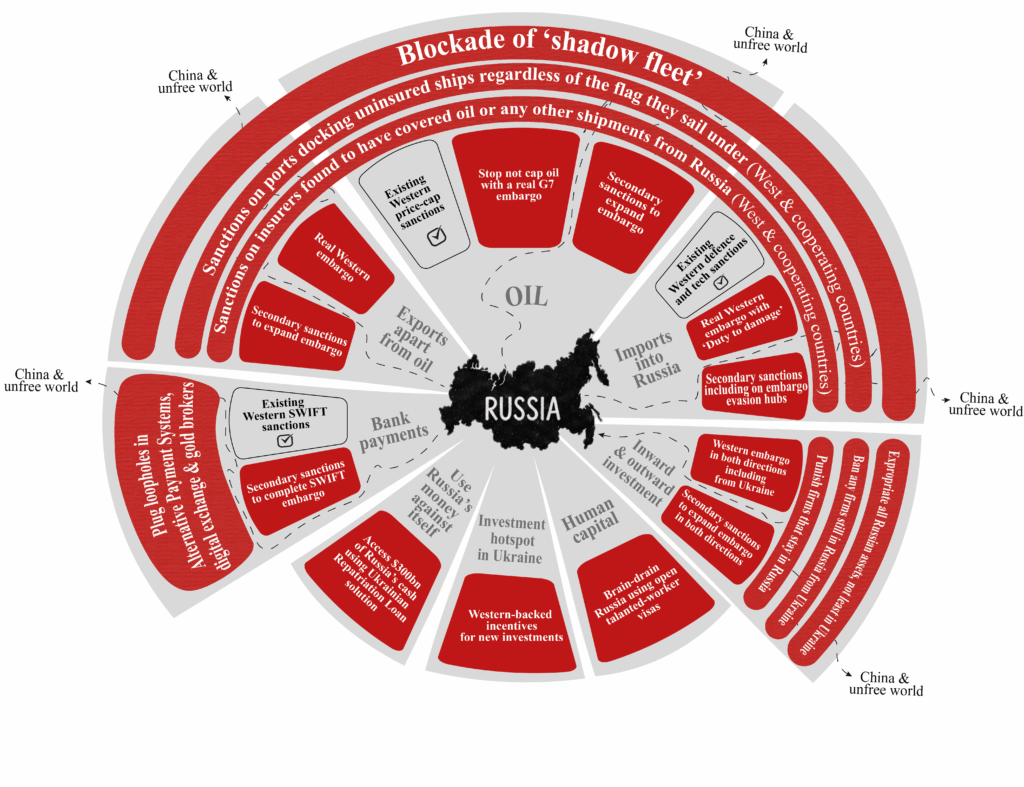
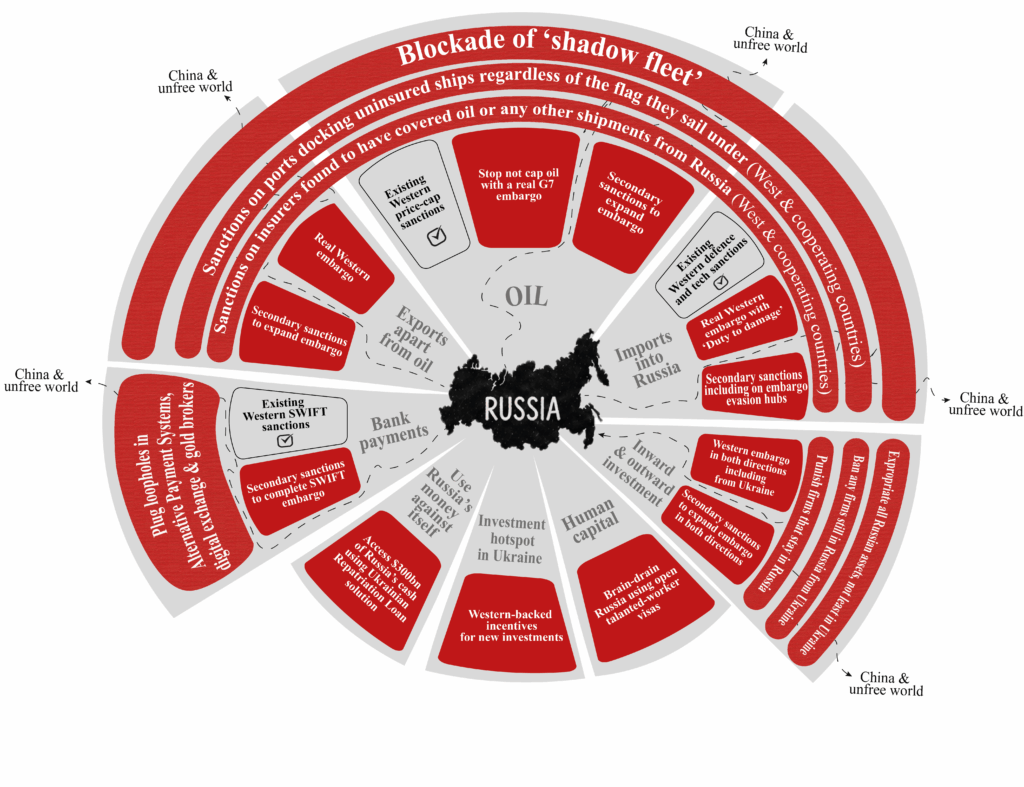
On 6 May, the London-based Moral Rating Agency published a 10-point operational plan and a diagram showing just three Western sanctions categories ticked against more than a dozen empty ones—and called for the formal declaration of “Economic World War” on Russia.
“There is a vast untapped opportunity to damage Russia through an Economic World War to make Putin unable to afford his invasion of Ukraine,” said Mark Dixon, the agency’s founder. “This is the realistic way to deal with a nuclear nation.”

Three checked boxes, a wheel mostly empty
The diagram shows what four years of Western policy looks like as one picture.
“When there are more loopholes than sanctions, they become loopholes in nothing.”
“The mathematical result of a percentage of a percentage of a percentage of a percentage produces a disappointing fraction of what is possible,” Dixon said in the press release.
“When there are more loopholes than sanctions, they become loopholes in nothing. The picture that Putin is looking at is closer to an open field with a handful of areas cordoned off with low fences.”
What the labels don’t say
The plan covers seven economic dimensions—oil, non-oil exports, imports, banking, investment, human capital, and Ukraine policy. The plan also calls for secondary sanctions on third-country banks still processing Russian transactions. Direct sanctions would hit the governments of Kazakhstan, Kyrgyzstan, and Armenia for hosting embargo-evasion hubs—not just the firms inside them.
A “duty to damage” provision would force Western firms to actively impede Russian use of previously-supplied products and services.
A “duty to damage” provision would force Western firms to actively impede Russian use of previously-supplied products and services, including software kill switches, with legal liability underwritten by sanctioning governments.
The tenth point: $300 billion (€277 billion) in frozen Russian central bank assets, mostly parked in Belgium, transferred to Ukraine via the Ukrainian Repatriation Loan structure. Russia’s own money, against itself.
“Nibbling at the devil”
Despite four years of Western sanctions, Russia exported $476 billion (€404 billion) of goods in 2024, not far off the $635 billion (€539 billion) peak of 2022 when it invaded Ukraine, the agency notes.
“The devil has been laughing at our naivety, lack of resolve and coordination.”
“The West has only been nibbling at the devil,” Dixon wrote, “while the devil has been laughing at our naivety, lack of resolve and coordination, hoping we won’t wake up.”
Desert island economy
Dixon’s endgame: deliver Putin’s regime into a “desert island economy”—one that can do business only with other dictatorships. To sink Russia, in his image, the West must surround it with as many “tornadoes” as possible across all economic dimensions.
“We must finish the job we started.”
“Western nations have the power to put Russia in the economic position that led to the collapse of the Soviet Union,” Dixon said in the release. “We must finish the job we started.”

The MRA’s economic war plan
- Bring the flow of Russian oil to an ebb. MRA proposes four things to do about oil. No more US de-sanctioning of G7 oil efforts, which only helps Russia sell oil and complicit countries like India buy cheap oil. No more capping the price of Russian oil, but a real embargo. Secondary sanctions are to be imposed on countries that still manage to buy what gets through by sea or pipeline. Ground Russia’s “shadow fleet” with insurance and port sanctions and, as needed, a naval blockade. This will force Russian oil into its own oversupply/reduced-demand sub-market at a significantly lower price.
- Upgrade from patchwork sanctions to a comprehensive trade and investment embargo. A total embargo on all Russian exports beyond oil, all imports, investments into and out of Russia across all sectors.
- Impose secondary sanctions across the board. To broaden the trade and investment embargo, secondary sanctions beyond what MRA is proposing for oil will force countries to choose between Russia and the West. This will polarize the world between what the MRA calls the “Single Democratic Market” and the “Undemocratic Market.”
- Unplug banking transactions properly. Secondary sanctions on third-country banks still processing Russian transactions, combined with a war on crypto-laundering and alternative payment routes Russia uses to bypass the Western banking system.
- Punish countries hosting trade embargo evasion hubs. Sanction the governments of countries like Kazakhstan, Kyrgyzstan, and Armenia that host sanctions-busting intermediaries, not just the companies themselves.
- Require a “duty to damage.” Legislation forcing Western companies to actively impede Russian use of previously-supplied products and services—including deploying software kill switches—with legal liability underwritten by sanctioning governments.
- Brain-drain Russia actively. A strategy to drain Russian talent with the specific goal of turning Russia into a particularly badly-run economy. This idea is well-hedged because, if Putin blocks their exit, he will only make the cleverest Russians hate him.
- Ukraine to sanction Russia aggressively. Ban companies still working with Russia from operating in Ukraine and expropriate Russian-owned companies still there.
- Make Ukraine an investment hotspot. Western-backed tax incentives for companies that exited Russia promptly, with extra incentives for Ukraine’s defense sector.
- Turn Russia’s money against itself. Get the $300 billion of frozen Russian money in Belgium to Ukraine via the Ukrainian Repatriation Loan solution.