
Russia unveils two counter-drone systems to stop Ukrainian UAVs. Defense analysts have questions about math
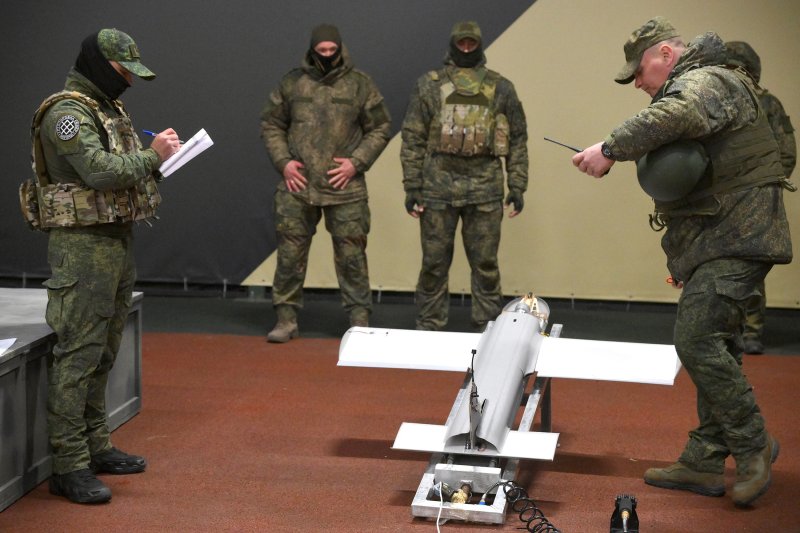
Russian propaganda media have announced two new "anti-aircraft drones" designed to counter Ukrainian strike and reconnaissance UAVs — the "Sokol-I" and the "Molniya-PVO". The published specifications raise questions about whether either can catch the Ukrainian Hornet and other fixed-wing drones they are meant to intercept, Defense Express reports.
Sokol-I: foam body, kinetic warhead, optimistic specs
According to Russian sources cited by Defense Express, the Sokol-I has a maximum speed of 150 km/h, a ceiling of up to 5,000 meters, a polystyrene foam body, and either a remote-detonation warhead or a kinetic one. It means it can be programmed to ram its target.
Day and thermal-imaging cameras provide target acquisition. The drone's stated mission is to counter Ukrainian fixed-wing strike and reconnaissance UAVs, including the Leleka, the Bulava, and the Hornet.
Russian sources have not disclosed the flight duration, the parameter that determines how many sorties operators need to fly to score a kill.
Molniya-PVO: built on existing kamikaze platform
The Molniya-PVO appears to be derived from the existing Molniya family of Russian kamikaze drones. Its name (literally "Lightning-Air Defense") indicates a counter-air variant of the platform, and visually it resembles a roughly half-scale copy of the twin-engine Molniya variant.
It carries a payload of up to one kilogram and can be launched either from a catapult or by hand. Its stated mission is to intercept larger Ukrainian bombing drones and fixed-wing strike UAVs.
As with the Sokol-I, the announcement leaves open how many launches operators will need to bring down a single target, and how many of the system Russia will actually produce.
What does Ukraine's Hornet do?
The Ukrainian Hornet is a fixed-wing strike and reconnaissance drone used in deep-strike operations against Russian targets, including air defense systems, command nodes, and rear-area logistics.
It can remain airborne for up to 2 hours, cover distances of up to 150 kilometers, typically operate at altitudes between 300 and 500 meters, and ascend to 5,000 meters to evade short-range air defense systems.
Read also
-
Ukraine announces its first “Equalizer” for asymmetric warfare: 250 kg warhead, no donor restrictions, third of US JDAM-ER cost
-
“Flash” Beskrestnov on Russia’s new threats to strike Kyiv: They have no dynamics on front and need result
-
Ukraine just added a new line to its Russian-losses ledger: ground robots. The count starts at 1,306