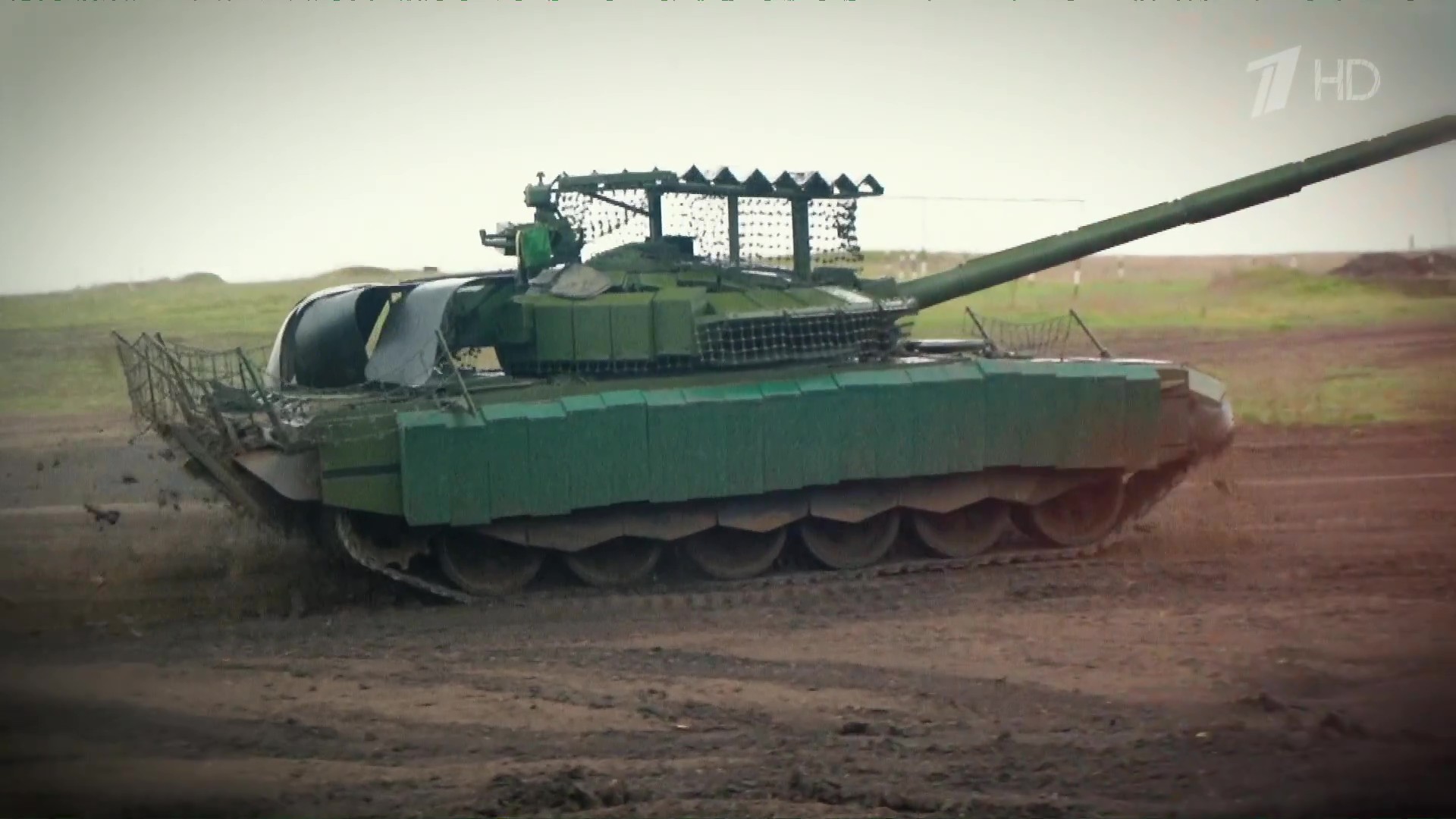
Russia has drained 72% of its Cold War tank reserve. Only 851 are left to restore.
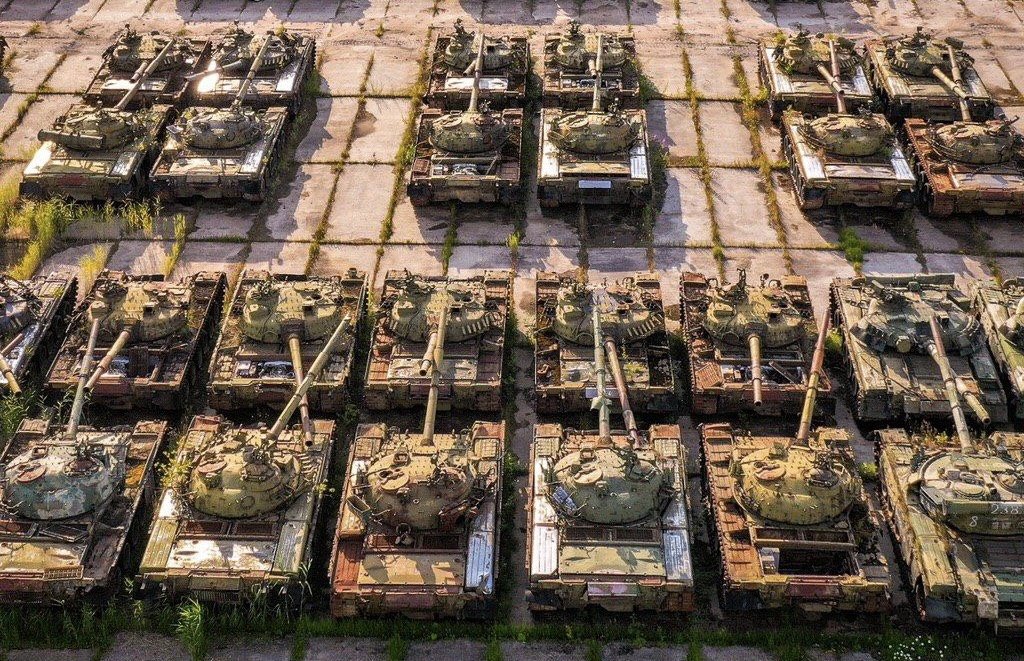
Russia has only 851 tanks in storage that remain viable for restoration, open-source analyst Jompy concluded on 9 June after a satellite-based analysis of nine Russian storage bases. The total of 2,088 remaining tanks is down sharply from 2,478 in October 2025—and from a pre-war stockpile of 7,342 in February 2022.
Russia is approaching the limits of its ability to refurbish Cold War-era armor to replace battlefield losses, even as Russian field armies have shifted to infantry-led assaults to shield their remaining tanks from Ukrainian drones.
How Russia drew down its tank stockpile
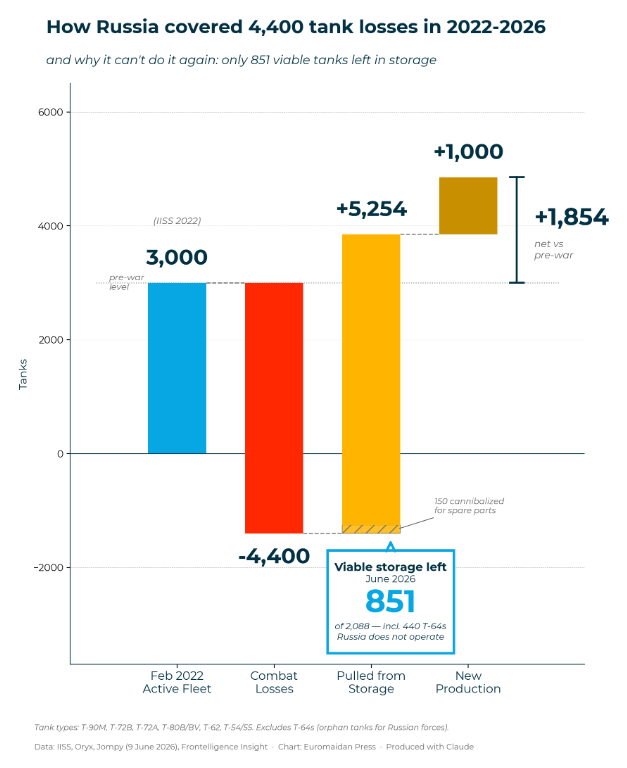
The chart above traces Russia's tank fleet over four years using four data sources: pre-war active strength estimated at around 3,000 tanks by the International Institute for Strategic Studies; combat losses visually confirmed at roughly 4,400 vehicles by open-source tracker Oryx; the volume removed from Cold War storage derived from Jompy's 9 June satellite analysis, which counted 2,088 remaining against a pre-war total of 7,342 across all 22 storage facilities; and new T-90M production at roughly 250 vehicles per year, per leaked Uralvagonzavod documents reported by Frontelligence Insight.
The result: by June 2026, Russia's active fleet exceeds its pre-war strength of around 3,000—but the storage stockpile that fueled the rebuild is nearly gone.
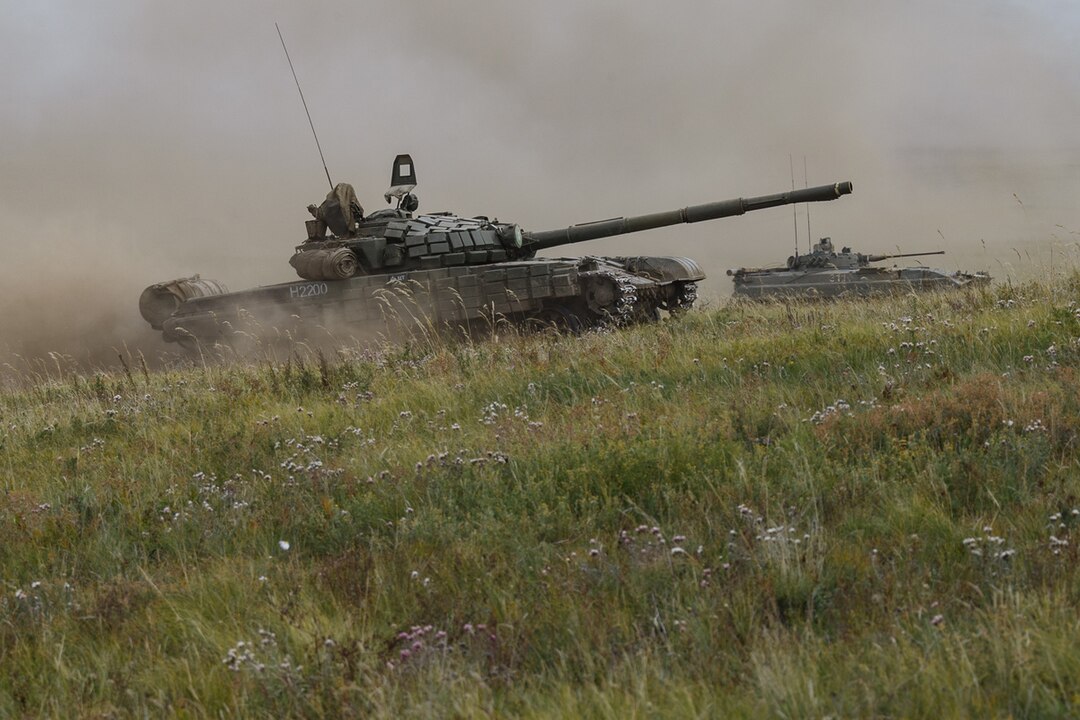
What's left in storage—and what's already scrap
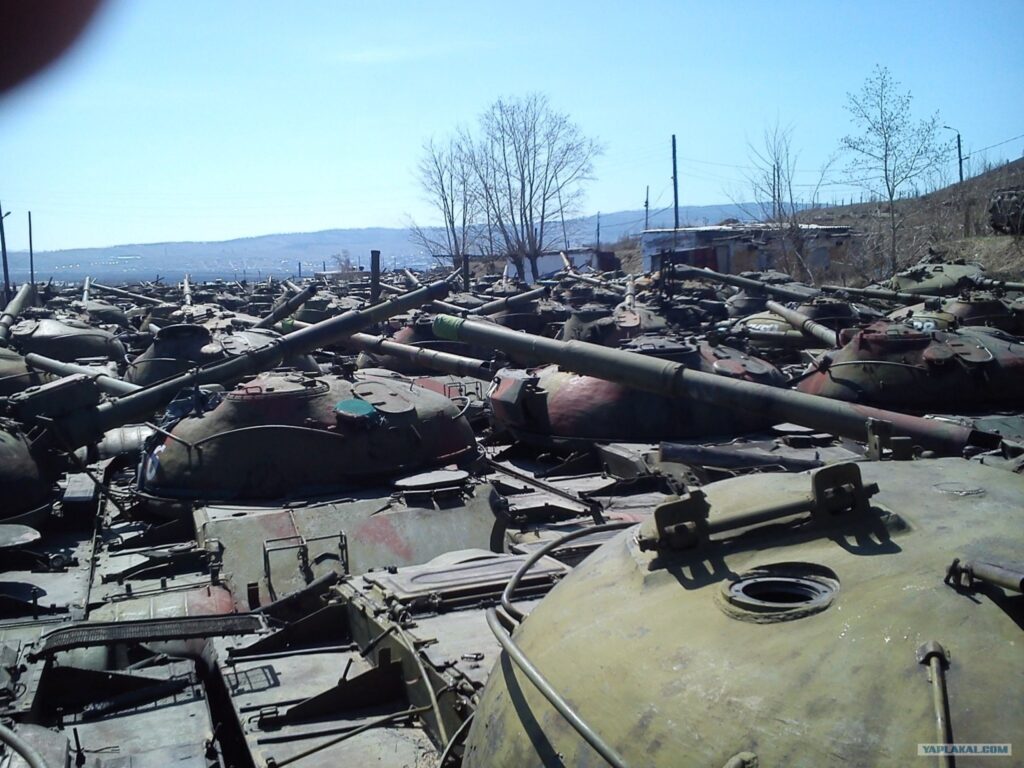
Of the 2,088 tanks remaining across nine storage bases, only about 851 are realistic restoration candidates—roughly 100 T-54/55s, 150 T-72As, residual stocks of T-62s, and the few well-preserved T-72Bs Russia still considers worth pulling. The remaining 1,237 are effectively dead inventory.
About 440 are T-64s—a Ukrainian-designed model the Russian army does not operate and is unlikely to adopt. "We should probably discard the remaining T-64s," Jompy concluded after a previous analysis. "Whatever few are pulled then and now, here and there, it's most likely they're either scrapped or cannibalized to get spare parts."
Another 250 T-72 Urals at the 349th storage base have not been selected for refurbishment, and roughly 200 T-62s at the 769th base have sat untouched for more than two years. The remainder has been cannibalized for spare parts.
Why Russia keeps draining the stockpile
The drawdown comes as Russian field armies have shifted to infantry-led assaults in 2025 to shield their remaining tanks from Ukrainian drones. Daily tank losses have fallen from dozens per day in 2024 to roughly one per day—but the stockpile continues to deplete anyway, as Moscow rebuilds a strategic reserve for some future, post-drone phase of the war.
David Axe reports on how Russia put that reserve together—and why it currently cannot deploy it at scale—for Euromaidan Press.
The rapid depletion closes off a key strategic option for the Kremlin. "The loss of the vast Soviet legacy stockpiles means the capability to quickly regenerate after high attritional warfare won't be there anymore for Russia and they'll have to change their approach to mechanized warfare," Jompy wrote in a recent analysis for Fronts.