
Putin claims Russia seized Pokrovsk — ISW finds no sign of that (MAP)
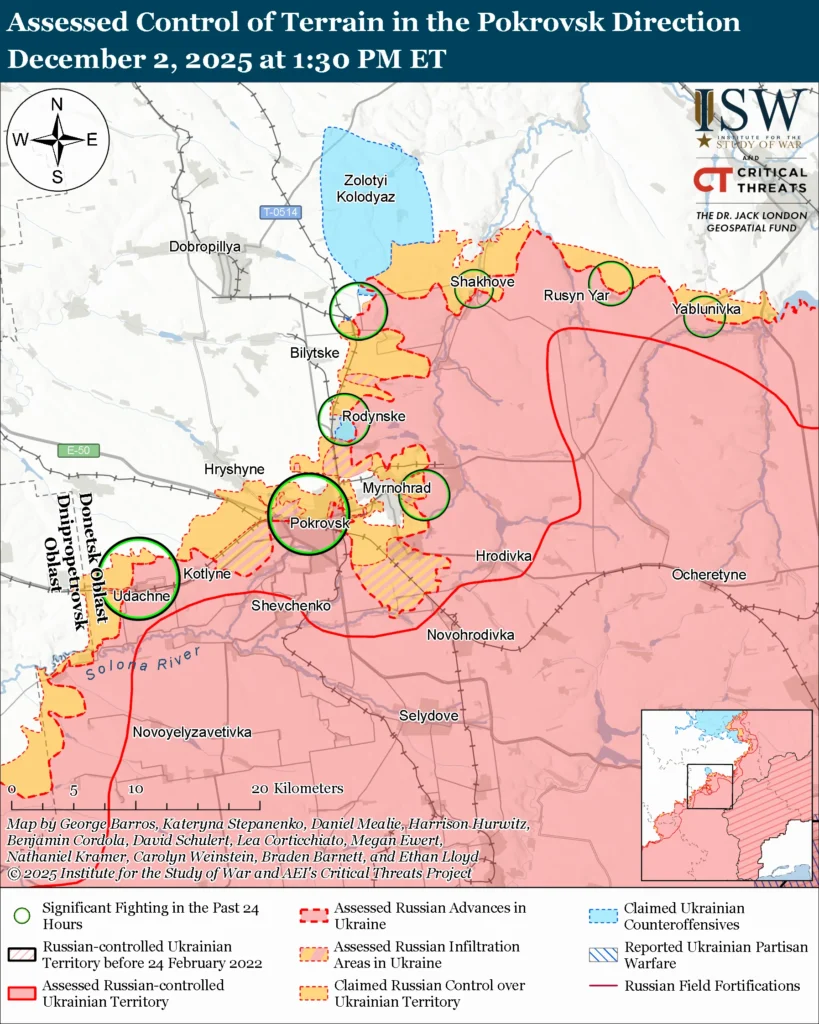

Russian President Vladimir Putin claimed on 2 December that Ukraine's city of Pokrovsk in Donetsk Oblast had been seized and would serve as a launchpad for further advances, according to the Institute for the Study of War (ISW). However, ISW found no evidence confirming the full Russian capture of the town and assessed that its fall would not enable major breakthroughs for Moscow.
The think tank wrote:
"ISW has not observed evidence to confirm the complete Russian seizure of Pokrovsk, but Russia’s seizure of the town in the near future is unlikely to produce rapid Russian advances."
Putin described Pokrovsk as a “good base” for achieving the goals he set at the start of the invasion. He said it offers Russian forces the ability to advance in “any direction” the General Staff considers promising.
Putin "exaggerated Russia’s claimed seizure of Pokrovsk," ISW says
The think tank dismissed Putin's claim as an overstatement, stressing that Russian forces are unlikely to achieve large-scale advances from the area.
Russian units will also face natural obstacles, such as terrain and water features, that limit rapid maneuvering. Past attempts in the nearby Dobropillia direction showed the same challenges, where Russian troops failed to widen a deep but narrow penetration or secure consistent supplies. The operational difficulties encountered then are expected to repeat now.
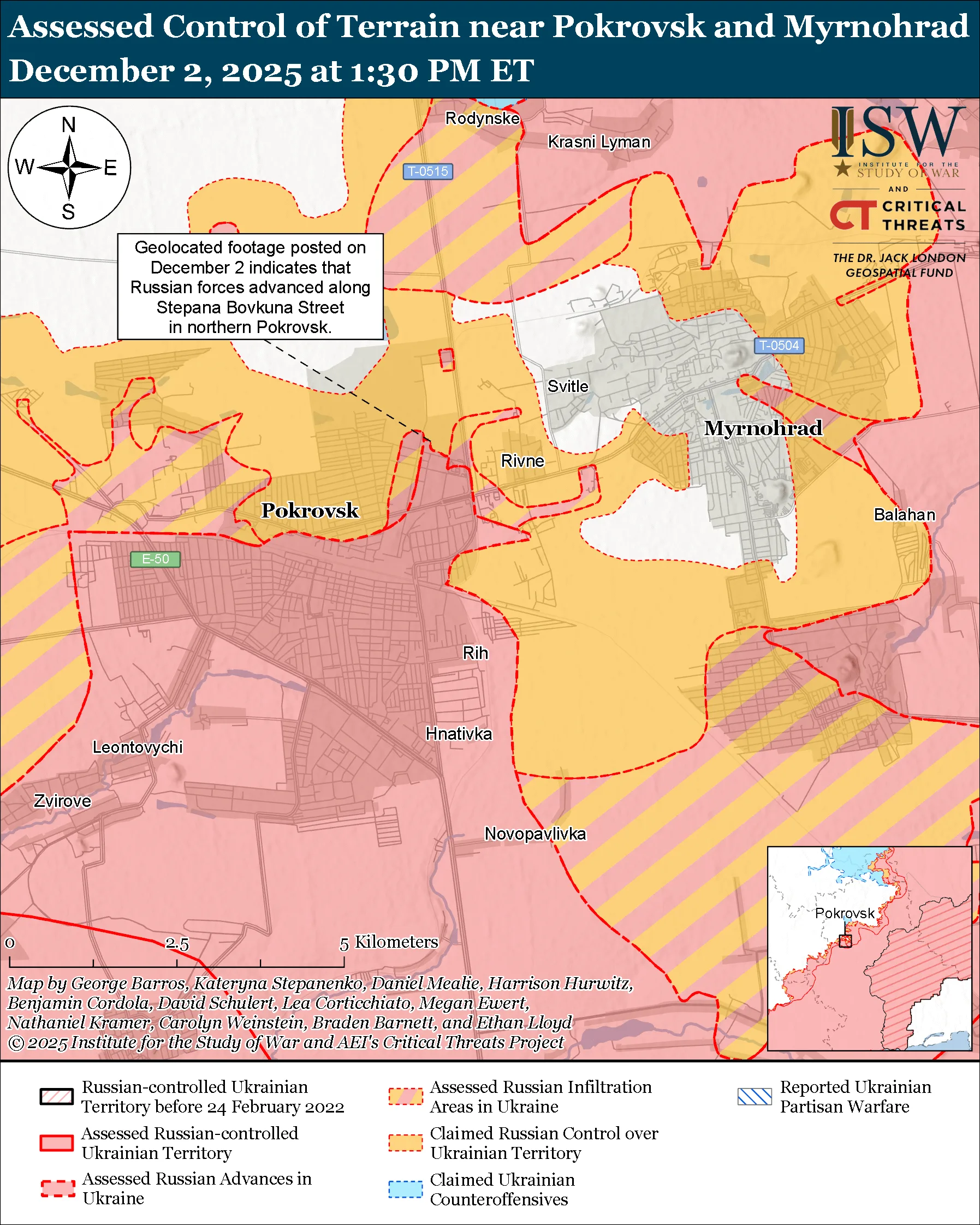
ISW assessed that the Russian units operating around Pokrovsk, including the 51st Combined Arms Army—previously the 1st Donetsk People’s Republic Army Corps—are severely degraded after suffering major losses in recent months. These elements have also failed to close the northern side of a potential encirclement of Ukrainian forces in the Pokrovsk-Myrnohrad pocket and have struggled to repel counterattacks from Dobropillia.
"ISW previously assessed that the Russian seizure of Pokrovsk would achieve an operationally significant effect of depriving Ukraine of its use of Pokrovsk as a logistics hub, but that Russia had already achieved this objective by July 2025," ISW wrote.
The broader strategic impact of controlling Pokrovsk now depends on how Ukraine withdraws, the strength of its follow-on defenses, and whether Russia has enough combat-ready forces to exploit any collapse in the area.
Fortress Belt remains unbroken
Even if Russian forces consolidate gains in Pokrovsk, ISW stated, this will not significantly help Russia achieve its broader objective of quickly seizing the entire Donetsk Oblast. Ukrainian troops still hold the Fortress Belt—an interconnected defensive line made up of major urban centers—which Russia has not captured any part of since 2022.
The Kremlin’s portrayal of Pokrovsk as a major turning point stands in contrast to the facts on the ground. ISW concluded that unless Russian troops overcome several entrenched obstacles, including force readiness, terrain limits, and strong Ukrainian fortifications, their position will remain stalled despite localized gains.
Read also
-
Russia has more armored vehicles now than in 2022. The math is ugly.
-
Ukraine’s frontline is place where humans can’t survive alone: Robots carry wounded through fire, retrieve disabled drones, recover vehicles (VIDEO)
-
NATO general: “I see no signs of waning support” as Ukraine’s 2% drone force inflicts half of Russian losses