Nine in ten Ukrainians back constructive approach to Poland history dispute, poll finds

Nine in ten Ukrainians support a constructive approach to resolving historical disputes with Poland, with the overwhelming majority rejecting the idea that either country should impose its historical narrative on the other, according to a Kyiv International Institute of Sociology (KIIS) poll conducted 17–23 June.
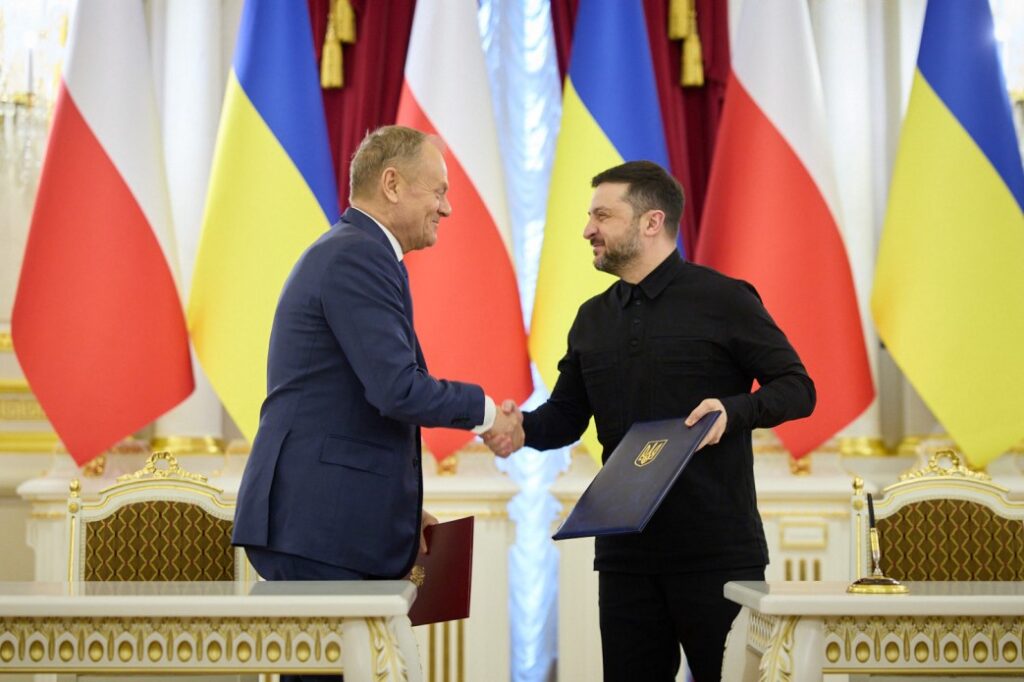
The survey comes amid a diplomatic rupture triggered by Polish President Karol Nawrocki's decision on 19 June to strip Ukrainian President Volodymyr Zelenskyy of the Order of the White Eagle, citing a Ukrainian military unit named after fighters of the Ukrainian Insurgent Army (UPA). Zelenskyy returned the decoration by post on 20 June.
What Ukrainians favour
KIIS polled 1,005 adults across government-controlled Ukrainian territory.
Asked "Ukraine and Poland have disputes on historical issues. Which approach do you support most?", respondents were offered four options. Fifty-seven percent chose the pragmatic position — that each country may have its own heroes and neither should interfere in the other's historical politics. A further 33% backed the formation of joint historian commissions, rather than political negotiations, to build a shared view.
Only 1% said Ukraine should comply with all Polish demands, and 4% said Poland should adopt the Ukrainian view — meaning just 5% overall endorsed a confrontational approach, KIIS reported.
The result was consistent across all regions and age groups. The pragmatic position was the plurality choice everywhere, from western oblasts (53%) to eastern ones (66%).
Social distance data
KIIS also released longitudinal data on Ukrainian attitudes toward Poles using the Bogardus social-distance scale, where 1 indicates willingness to accept someone as a family member and 7 means refusing them entry to Ukraine.
The score for Poles stood at 3.0 in 2022 and 2.9 in September 2023 — the closest Ukrainians had ever placed Poles in nearly three decades of monitoring, reflecting gratitude for Polish support following Russia's full-scale invasion. It rose to 4.0 in 2024 and 4.1 in 2025, a level KIIS describes as within the range of tolerant attitudes. For comparison, Russian residents of Russia score 6.5 on the same scale; Ukrainian-speaking Ukrainians score 2.4.
KIIS noted that the deterioration after 2023 began in response to the Polish border blockade that started in late 2023, and that the 2025 figure showed no statistically significant change from 2024 despite anti-Ukrainian rhetoric during Poland's presidential election campaign that year.
Attitudes toward OUN-UPA
The institute also released data on Ukrainian perceptions of the Organisation of Ukrainian Nationalists and the Ukrainian Insurgent Army (OUN-UPA) during the Second World War, drawn from earlier surveys.
In 2013, 48% of respondents evaluated OUN-UPA's wartime activity negatively and 19% positively. By 2025, negative evaluations had fallen to 8%, while 37% gave positive assessments; 50% selected the "hard to say" option, which KIIS read as reflecting genuine gaps in historical knowledge rather than concealed opinion.
KIIS commentary
"The results of our surveys show that Ukrainian society approaches the question of historical disputes with Poland in a fairly mature and constructive way," KIIS executive director Anton Hrushetsky said. "Almost all Ukrainians are against imposing the Polish view of shared history on Ukraine, and at the same time only a small share of Ukrainians want to impose the Ukrainian view on Poland."
Hrushetsky added that no anti-Polish sentiment was observable in Ukrainian society: "Even in 2025, after an election campaign in Poland that used anti-Ukrainian slogans, we did not observe a significant worsening of attitudes toward Poles."
Ukraine's Foreign Ministry said ahead of the poll's release that it was conducting diplomatic work with Warsaw to manage the escalation.