
Mystery drones may be forcing Europe to choose: defend at home or arm Ukraine
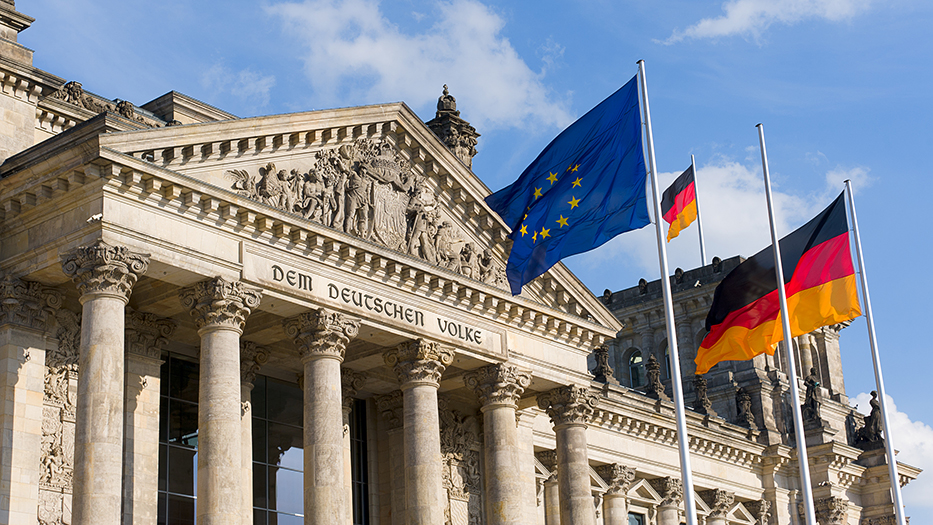
European states appear spooked by the growing trend of drone sightings in their territories, which many are attributing to Russia.
More countries are raising spending and creating task forces to counter these machines. The latest reaction came from Germany, which has created a Joint Drone Defense Center in Berlin. Days earlier, the Dutch Ministry of Defense tapped Rheinmetall to deliver Skyranger air defense systems worth hundreds of millions of euros, citing the growing drone danger.
These actions suggest that Russia is being seen as more of a threat in northwestern Europe. Politicians in Germany, Denmark, the Netherlands, and elsewhere, have stated that a foreign power is likely behind these incidents.
Security experts told Euromaidan Press that Russia may be probing European countries’ resolve and defensive readiness. Moscow may also be trying to exacerbate uncertainty and stretch resources, under the logic that spending on anti-drone security at home is aid that doesn’t go to Ukraine to fight off Russia.
"These drone incidents... have definitely increased the perception of Russia as an adversary. And that is feeding desires to re-arm," said Marc DeVore, a defense policy scholar, who advised the UK’s Foreign Office on Russia’s full-scale invasion.
"On the other hand, they ram home the vulnerability within European states, which is probably leading to less of a focus on how to help Ukraine prevail, and more of a focus on being prepared themselves to counter Russian aggression."
Moreover, European countries are in disagreement over the extent of Russia’s threat, which Russia may be trying to exploit. While nations like Poland and the Baltic states believe they are already at war, states farther west still see themselves on a peacetime footing, observers said. Discord over spending may be a way to drive a wedge in European unity.
Anton Zemlyanyi, a senior analyst with the Ukrainian Security and Cooperation Center, believes that Russia is taking advantage of this uncertainty.
"The Alliance has repeatedly stated its readiness to defend its territory and interests," Zemlyanyi said.
“However, the vague reaction of most NATO countries to past provocations, in particular with drones, only fuels the Russians’ determination to act further and intensify their hybrid aggression.”
Mystery drones loom larger over Europe
About 60 drone sightings were reported from August to November 2025, with more coming in December.
An analysis of publicly available reports by Euronews' fact-checking unit found that drone-related disruptions at European airports have quadrupled between January 2024 and November 2025.
Unidentified drones were detected in Poland, Germany, Sweden, Denmark, Norway, Belgium, Estonia, Spain, the United Kingdom, Finland, and Lithuania. Some were discovered near military sites, such as the French nuclear submarine base at Île Longue.
Drones were also spotted off the coast of Dublin, just as the plane carrying President Volodymyr Zelenskyy was about to land ahead of his first visit to Ireland in December.
Moscow has repeatedly denied responsibility.
Indeed, it’s hard to say to what degree Russia is involved in these incidents. According to Dutch newspaper Trouw, the vast majority of recent drone sightings have not shown evidence of Russian involvement.
DeVore said that part of the trend may be explained by the commonality of civilian models and heightened vigilance towards drones in recent months.
However, "there's a high probability that Russian activity may be behind some of the drones," he added. “It's quite likely that Russia is engaged in drone preparations if not operations in the West.
"The other thing we've learned is that doing this seems to be relatively easy," he said — smuggling Russian drones into Europe is unnecessary, as parts are easy to buy and assemble.
"It's a perfect deniable operation... all Russia needs to do is get the humans in place. There would likely be no Russian parts and nothing direct, forensically linking it to Russia. I'd say it's very difficult to prove Russia is behind it."
Still, hints of Moscow’s involvement can be read in the margins. The Molfar Intelligence Institute recently uncovered a Russian operation to buy European SIM cards for use in drone guidance systems. The list of mobile operators these SIM cards belong to “almost exactly matches the countries where ‘unidentified’ drones were spotted,” according to the report.
“Similar provocative actions with air targets have been used by the Russian Federation more than once as a tool of hybrid pressure on NATO,” Zemlyanyi said.
“Actually, similar cases with drones should be considered as similar cases with Russian aircraft in the airspace of Estonia. When the Russians deliberately provoke and even intimidate European countries.”
DeVore said that uncovering the extent of Russia’s involvement likely falls to intelligence and counter-intelligence operations.
Germany to treat drones like ISIS
Germany’s latest move seems to stem from a similar conclusion.
The new drone defense center is the work of both the federal and local governments. It's based at the Federal Police HQ, where the security authorities, the German armed forces and intelligence services will exchange information and coordinate measures. It's based on the joint counter-terrorism center model, designed to deal with Islamist terror.
Drone defense efforts are primarily focused on airports, military bases, and energy providers. According to the German government, drone sightings at key facilities in Germany have increased sharply since the start of Russia's war of aggression in Ukraine.
"We largely assume that these drones are also controlled by hostile powers," Federal Interior Minister Alexander Dobrindt was quoted as saying.
German interior ministers on the local and federal levels have agreed that police could not handle defense against larger military drones on their own.
Germany’s cabinet has also approved a reform of the Air Security Act. Parliament is now reviewing these changes, which revise the conditions under which the armed forces can aid the police, and provides for how drones can be bought down.
At the beginning of the month, Dobrindt commissioned a new unit of the Federal Police for drone defense. It will be stationed at airports, in the capital, and near sites important for nationwide security, for quicker response times.
What is Russia trying to accomplish?
If Russia is behind these drone incidents, it may be trying to accomplish one or more of several results.
One possibility is that Russia is looking to set up the possibility of preemptive military operations, while testing European countries’ readiness.
Another possibility is that this is part of Russia’s operations below the threshold of a direct military threat — a way to remind European countries that they’re vulnerable, analysts said. This is a way to raise domestic uncertainty and drive a wedge between countries that feel more and less threatened.
Probing with drones may lead to more threatened countries to want to increase spending on drone defense, which may be resisted by allies that are less concerned, he said.
Russia may also be trying to stretch European allies’ anti-drone capabilities, to make less financing available to Ukraine.
“So, there may be a real choice if you're a policy maker in Germany, the UK, or Belgium: do you send your new drone detecting radars, or your new anti-drone interceptors to Ukraine?” DeVore said. “Or do you deploy them around your own military sites?”
Furthermore, deploying serious anti-drone measures, such as electronic warfare systems, may be an unpopular measure in multiple European countries. These systems can mess with civilian lives by disrupting flights or GPS systems in personal vehicles.
“Russian special services have found a new way to develop their provocations and sabotage actions, which can be harmful for European countries, in terms of politics, economy and security,” Zemlyanyi said.
“The Russian hybrid strategy works below the threshold of direct aggression, putting European countries in a state of constant readiness,” he added. “As the German Chancellor previously stated, the EU is not in a state of war, but not in a state of peace either.”


