More land, more war, no regrets: Russia’s demands to Ukraine in Istanbul


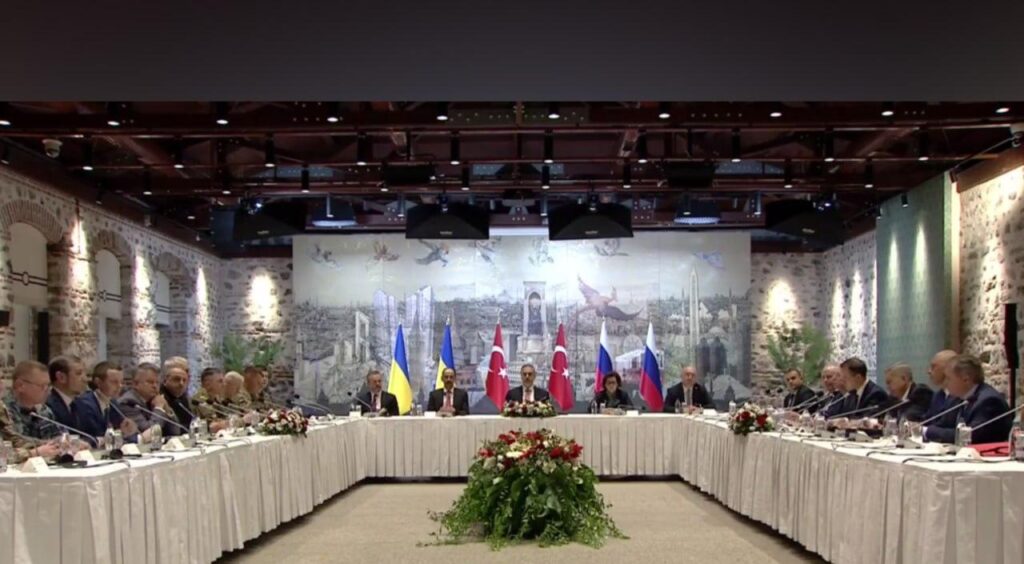
In negotiations held in Istanbul, Russia issued sweeping demands to Ukraine, including the full handover of four occupied regions and formal recognition of Crimea as Russian territory. If these conditions are not met, Russian officials warned they would seek to seize two more regions — Kharkiv and Sumy.
Ukraine had entered the talks calling for a 30-day ceasefire and proposed a direct meeting between Presidents Vladimir Putin and Volodymyr Zelenskyy. The Russian side instead escalated demands and invoked historical conflicts as a warning of prolonged warfare.
More land or more war
The ultimatum was first reported by The Economist journalist Oliver Carroll and confirmed by Russian state media host Yevgeny Popov. According to one Russian negotiator, failure to accept the current terms would lead to future claims over six regions.
Ukrainian MP Oleksiy Honcharenko added that Moscow also pushed for a “security zone” in Sumy Oblast.
Russian delegation head Vladimir Medinsky framed the demands as a continuation of earlier proposals from the war’s outset, saying terms have become “harsher” since the first rounds of talks in Gomel and Istanbul.
According to Suspilne and Bloomberg, Russia insisted that Ukraine recognize Crimea as part of the Russian Federation. The Washington Post reported that Ukrainian officials flatly rejected any transfer of territory beyond what Russia currently controls.
Both sides acknowledged that a potential ceasefire was on the table. Ukrainian negotiator Rustem Umerov said Kyiv requested a direct meeting between Putin and Zelenskyy. Medinsky confirmed that Moscow had “taken note” of the proposal.
Further ceasefire negotiations are expected, pending each side’s presentation of their terms.
Ready for a long fight
In an interview with Russian state TV host Yevgeny Popov, Vladimir Medinsky dismissed calls for a ceasefire ahead of substantive negotiations, stating that such proposals come from people “who don’t know history.” To support his point, he cited several historical examples — including the Vietnam War.
Russian political analyst Vladimir Frolov has previously written that Moscow is planning to conduct direct negotiations with both Ukraine and the United States based on the model of US–North Vietnam talks in the early 1970s. Those talks, supported by the Soviet Union, took place during ongoing hostilities and ultimately culminated in the US evacuation from Saigon on 30 April 1975. According to Frolov, the Kremlin is seeking a similar outcome — a symbolic and strategic withdrawal, with Kyiv replacing Saigon as the focal point.
Medinsky reinforced this perspective during the Istanbul talks. According to The Economist’s Oliver Carroll, he told Ukrainian negotiators: “We don’t want war, but we’re ready to fight for a year, two, three — however long it takes. We fought Sweden for 21 years. How long are you willing to fight?” He also invoked Peter the Great and declared that Russia is “ready to fight forever,” suggesting that continued resistance would result in even greater losses.
Russian media later confirmed that the Great Northern War was raised in the talks as an example of how early refusal to compromise can lead to harsher outcomes.

Sanctions on the table
Following the talks, leaders from the UK, France, Germany, Poland, and Ukraine held urgent consultations with US President Donald Trump. Reports suggest European countries are considering stricter sanctions against Russia.
The US has not yet issued an official response. Trump has previously said that only a direct meeting between him and Putin could end the current diplomatic deadlock.
Read also
-
Russia and Ukraine agree to largest-ever prisoner swap—but peace talks in Istanbul stall over Putin’s “outrageous” demands
-
“Maybe more of your loved ones will die”: Russia’s threat at Ukraine peace talks revealed
-
Pope Leo XIV offers to host Russia-Ukraine talks, calls Istanbul peace attempt “tragic”