Merz to the rescue as EU races to bypass Belgium on Russia’s €210bn
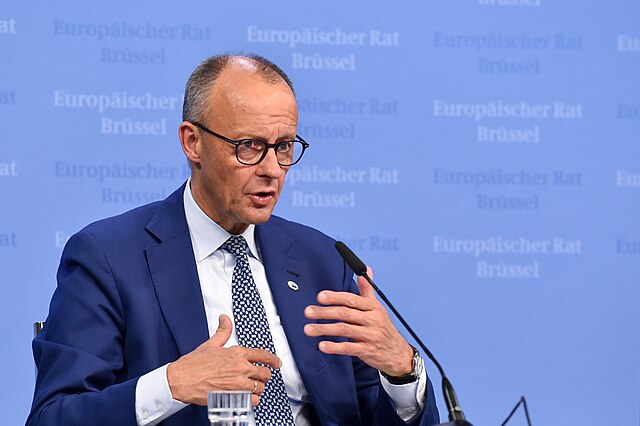
German Chancellor Friedrich Merz arrived in Brussels on Friday for emergency talks with Belgian Prime Minister Bart De Wever and European Commission President Ursula von der Leyen over €210 billion in frozen Russian assets.
The trilateral meeting comes two weeks before EU leaders vote on a plan to channel the frozen funds into a reparations loan for Ukraine — and amid growing concern that Washington wants a cut.
“This is a European matter, and I see no way, in any form of economic benefit, to transfer the money we then mobilize to the United States of America,” Merz said in Berlin on Thursday.
The comment was a direct response to Point 14 of a leaked US-Russia peace plan, which proposed splitting the frozen assets into investment vehicles that would allow both Washington and Moscow to profit commercially, rather than compensating Ukraine for war damage.
Belgium holds the key
Most of the frozen Russian Central Bank assets — €183 billion — sit at Euroclear, a financial clearinghouse in Brussels. Belgium has blocked the EU’s reparations loan plan, with De Wever calling the approach “fundamentally wrong” and warning that Russian litigation could “mean bankruptcy for Belgium.”
De Wever demanded legally binding guarantees that all EU members share any financial risk. So far, only Germany has agreed. Other members have been less forthcoming.
“When I bring it up, everyone else just looks at their shoes or the ceiling of the meeting room,” De Wever told German broadcaster Tagesschau.
Merz has publicly backed risk-sharing. In an op-ed published Wednesday, he wrote: “It would be unacceptable for any single country to bear a disproportionate burden.”
But he framed the stakes in broader terms: “If we are serious about this, we cannot leave it to non-European states to decide what happens to the financial resources of an aggressor state that have been lawfully frozen within the jurisdiction of our own rule-of-law and in our own currency.”
The Hungary-proof mechanism
The European Commission’s proposal includes a legal innovation: using Article 122 of the EU treaties to prevent any single member state from vetoing sanctions renewal. Under this mechanism, a qualified majority—15 of 27 members representing 65% of the EU’s population—could extend the asset freeze indefinitely.
Von der Leyen stated the plan “requires only a qualified majority,” signaling the Commission could proceed even over Belgium’s objection.
The EU summit on 18-19 December will determine whether Europe can unite behind the reparations loan, or whether internal divisions hand leverage back to Moscow and Washington.
Ukraine’s budget runs dry in April. The country needs €135 billion through 2027 to sustain both military operations and basic government functions.