Memory Under Fire: Free online course examines the Holodomor as Russia denies the genocide and attacks Ukraine’s past

In late March 1933, a young Welsh journalist named Gareth Jones walked alone through Soviet Ukraine, slept in peasant huts, and listened. On 29 March, he returned to Berlin and issued a press release that the Manchester Guardian carried within days.
"There is hunger almost everywhere. Millions die from it. I travelled for several days in Ukraine, and there was no bread. The children had stomachaches, all the horses and cows were dying, and the people were also dying of hunger. The terror was on an unheard-of scale."— Gareth Jones in the Manchester Guardian, March 1933
For his trouble, Jones was banned from the USSR and mocked by name in the New York Times. Two years later, in 1935, he was shot dead in Inner Mongolia, on the eve of his thirtieth birthday. He did not live to see his findings vindicated.
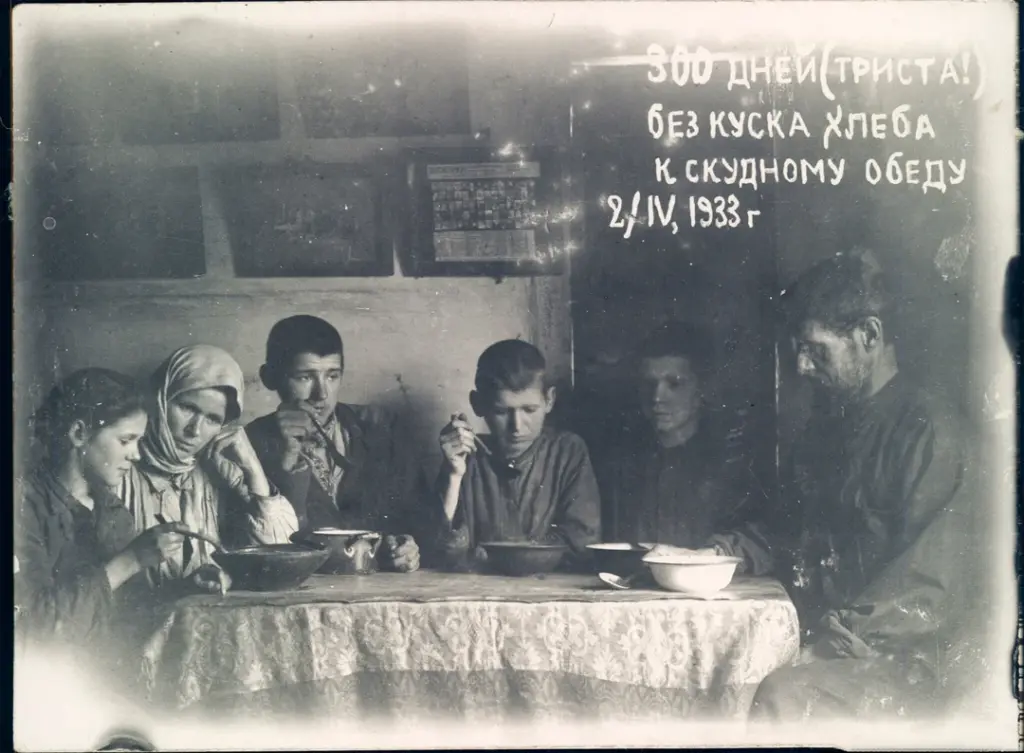
While Jones's dispatch traveled west, an amateur photographer named Mykola Bokan was making his own record from inside the famine.
Four days after Jones's press release, Bokan photographed his family at their lunch table and inscribed the print: "300 days (three hundred!) without a piece of bread to add to the meager lunch." The picture may be found at the top of this article.
Three months later, Bokan's son Kostiantyn was dead. He had collapsed on the road home from the collective farm at twenty-two.
On 10 July 1933, Bokan sat his remaining children around a smaller table. Between them was a framed portrait of Kostiantyn. He took the photograph and inscribed it: "Remembrance for Kostia, who died of starvation."
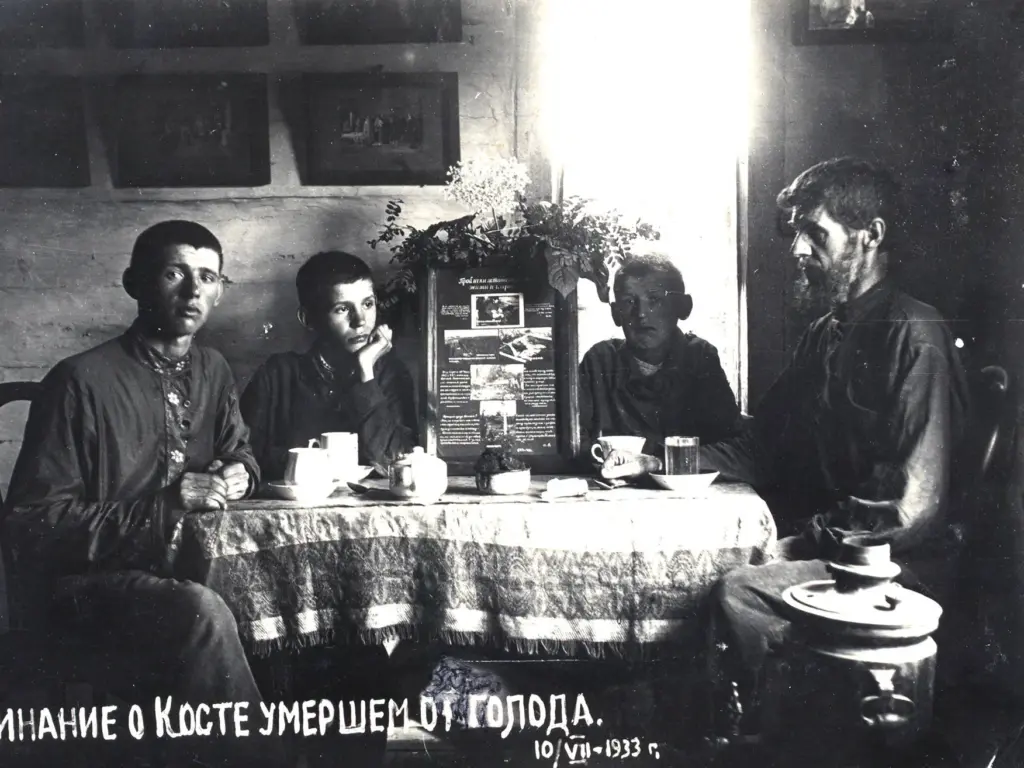
Bokan was arrested for "counter-revolutionary activities" (the photographs among the evidence). He would eventually die in the Soviet camp system, while his photographs sat in a secret police case file until researchers found them in 2007.
In the decades since Jones's dispatches and Bokan's photographs, knowledge of the Holodomor has moved far beyond the first eyewitness accounts. Survivor testimony has been collected, foreign diplomatic cables have been declassified, previously locked archives have been opened to researchers and members of the public, and a generation of historians has reconstructed the famine's political design in far greater detail. What was once known largely through fragments has become a field of academic study and an atrocity infamous the world over.
A couple of months ago, on 23 March 2026, the new Holodomor course went live on Coursera. Famine as Genocide: The Holodomor in Ukraine runs thirteen modules, free, in any country with an internet connection.
Built over three years by the Holodomor Research and Education Consortium (HREC) of the Canadian Institute of Ukrainian Studies at the University of Alberta, the online course covers the famine itself, survivor testimony from those who lived through it, the parallel destruction of Ukrainian culture, the new science of intergenerational trauma, and ninety years of denial.
The launch of UAlberta/HREC's course comes seventy-seven days after the Russian Foreign Ministry added twenty-eight Canadian citizens to a list of people barred from entering Russia. Most were HREC scholars. Among them was Marta Baziuk, the consortium's executive director, who agreed to talk to Euromaidan Press about her experience and, more broadly, the course's content.
The Holodomor's continuing relevance
The USSR that strove to erase Jones and Bokan’s testimony is gone. Yet one of its successor states, the Russian Federation, has inherited Red Moscow’s habits, punishing those who investigate the Holodomor and starving beleaguered Ukrainian civilians under occupation.
In late 2023, Russian-installed authorities on the occupied eastern bank of the Dnipro tore down Holodomor memorials in Nova Kakhovka and the Oleshky community. Two years later, in Oleshky itself, roughly two thousand civilians have been living under siege since December 2025, cut off from food and medicine as mined roads, FPV drones, and the wreckage of the Kakhovka dam close around them. Residents have begun dying of hunger and cold.
Russia follows in the footsteps of the USSR's cultural genocide of Ukraine, liquidating Ukraine's writers, scholars, and clergy. Indeed, Raphael Lemkin, who coined the term "genocide," called the Holodomor the classic example of Soviet genocide in 1953. Lemkin described the campaign as a four-pronged assault: on cultural figures, clergy, the peasantry, and Ukrainian national identity through the resettlement of Ukraine with non-Ukrainians.
Russia’s present war on Ukraine has followed the same four-pronged logic. Scores of civic leaders, mayors, journalists, and cultural figures have been killed or have disappeared. The Orthodox Church of Ukraine and the Ukrainian Greek Catholic Church have been persecuted under occupation. At least twenty thousand Ukrainian children have been forcibly transferred into Russia, the crime behind the ICC’s March 2023 arrest warrant for Vladimir Putin.
It is into this moment that HREC's Holodomor course launches.
What was the Holodomor?
Between 1932 and 1933, a man-made famine struck Soviet Ukraine. Scholarly estimates of the death toll range from 3.5 to 5 million Ukrainians. Most demographic studies cluster near 3.9 million direct excess deaths.
Most deaths occurred in the winter of 1932 and the spring and summer of 1933, as Soviet collectivization emptied whole villages of life.
The 1932 harvest was poor. Drought had hit parts of the Soviet grain belt that summer. But the famine that followed was not natural.
Stalin's government set grain procurement quotas that Ukraine could not meet. Brigades went into the villages to take what remained, including seed grain. Villages that fell short were placed on blacklists, barring them from buying any goods until they met the quota. Peasants were forbidden to leave Ukraine in search of food.
Collectivization had been driving the same logic since 1929. Peasants resisted being forced off their land and onto collective farms; the state responded by escalating violence and seizure.
The campaign against the "kulaks" was the sharpest edge of that escalation. Kulak was a Soviet slur for a supposedly wealthy peasant; in practice, it applied to anyone with a few cows, a larger plot, or the inclination to resist collectivization. Hundreds of thousands were deported or shot. The villages lost their most experienced farmers exactly when those skills were needed most.
Ukraine commemorates the Holodomor on the fourth Saturday of November, with a national minute of silence at 16:00. The National Museum of the Holodomor-Genocide in Kyiv holds the country's largest archive of survivor testimony, photographs, and case-file material from 1932-33.
The past is not past: what UAlberta and HREC's course adds to the conversation about the Holodomor
The Holodomor course is the culmination of three years of work by the Holodomor Research and Education Consortium (HREC) at the University of Alberta's Canadian Institute of Ukrainian Studies.
The course could not have been built before now. The Soviet archives stayed locked until the early 1990s, and until they opened, anyone studying the famine worked from émigré memory and the cables foreign consuls had sent home in 1933.
"The amount of research that's been done in the last twelve years, the networks of scholars that have been developed... there's really a field today called Holodomor studies," Baziuk said. "There are enough people working within it."
For decades, the Holodomor was told as starvation alone. Not only the mental effects but also the physical ones linger among those who survived and continue to surface in their descendants, a point UAlberta/HREC's course makes explicit.
One reference case is the Dutch Hunger Winter, caused by a German blockade in late 1944 during World War II. Children conceived during it showed lifelong DNA changes for genes regulating growth and metabolism. Six decades later, the "starved" cohort showed accelerated biological aging and elevated risk of Type 2 diabetes and cardiovascular disease.
Researchers studying three generations of Holodomor survivor families have documented what they describe as "living in survival mode"—stress, mistrust, food hoarding—in grandchildren who have never themselves gone hungry. A 2026 review of the multi-generational trauma literature grouped Holodomor descendants with the Dutch and Holocaust cohorts.
"When Ukrainians look back at the Holodomor, people are more convinced that it was genocidal in the context of the war today. I think it makes it easier for them to believe that now." — Marta Baziuk, Executive Director, Holodomor Research and Education Consortium, in interview with Euromaidan Press
New demographic research has sharpened the picture from another direction: even outside the Ukrainian Soviet republic, and even in mixed villages, ethnic Ukrainians died at measurably higher rates than their neighbors.
What made the Holodomor course possible was the development of the field of Holodomor studies. Yet what unfortunately broadened the audience was Russia's war against Ukraine.
"The war has made Ukrainian history important to a lot of people," Baziuk said. "It might have been as good a course, but it would have sat quietly, with less interest."
The Executed Renaissance: the Holodomor as part of broader Soviet repressions
Above all, the course refuses to let the Holodomor stand alone. The famine sits inside a larger Soviet pattern, and the course makes that pattern visible.
Across the same months, the Soviet state was killing Kazakhs. The campaign in Kazakhstan drove nomadic herders off the steppe and onto collective farms, regardless of whether their way of life could survive collectivization. It could not.
Around 1.5 million people died, by some counts, close to 40 percent of the ethnic Kazakh population. Kazakh historians call it the Asharshylyq.
The standard scholarly account, drawing on archives that opened in the 1990s, has had the same effect in Kazakhstan that Anne Applebaum's Red Famine had in the West. It opened a public reckoning that the Soviet period had foreclosed.
Inside Ukraine, the famine ran alongside a coordinated effort to suppress Ukrainian culture and replace it with a Kremlin-approved Soviet version.
The opening move came in 1930. Soviet security services invented a fictional underground group called the "Union for the Liberation of Ukraine" and put forty-five Ukrainian writers, scholars, and clergymen on trial for membership in it.
Over the next decade, roughly 30,000 more would be arrested, deported, or executed. Of the 259 Ukrainian writers who published in 1930, only 36 were still publishing after 1938. Many of them either wasted away behind bars or ended up at the bottom of mass graves at places like Sandarmokh.
The generation that emerged in the 1920s and died in the 1930s has come to be called the Executed Renaissance.
Many of those killed were themselves committed Communists. In the 1920s, the Bolsheviks had little organic support in Ukraine, and they had recruited young, idealistic Ukrainians by promising room for a Ukrainian version of socialism.
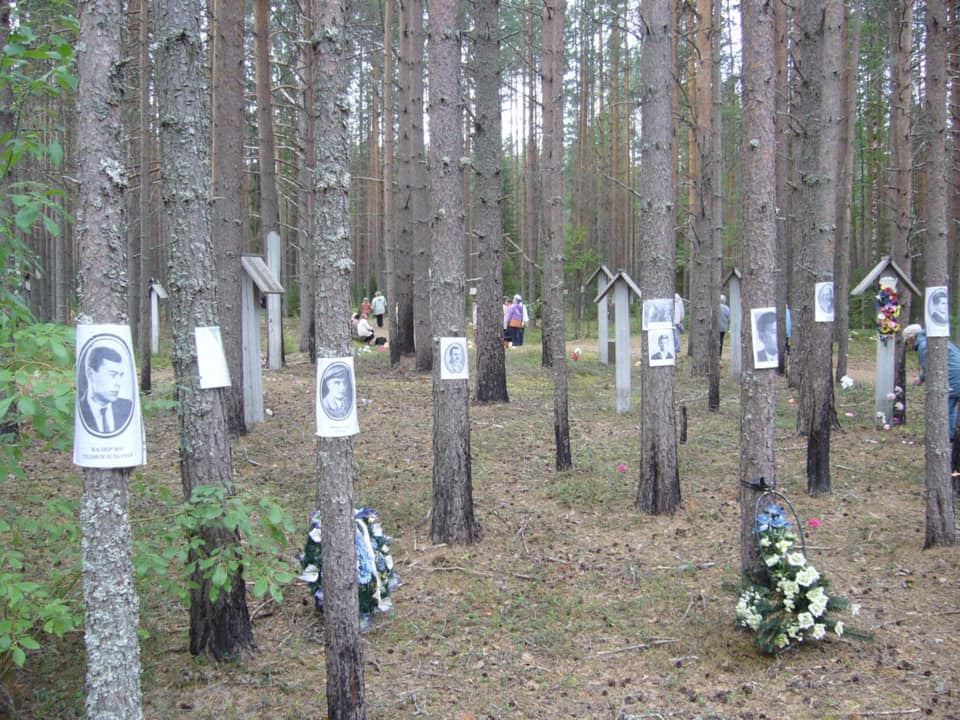
The promises of korenizatsia, the Soviet promotion of non-Russian nationalities, and of a Soviet Union free from "Great Russian chauvinism," gave way to Stalin's Great Turn: a Soviet state recentered on Moscow's ambitions and imperatives. In that order, Ukrainian national communists were, at best, relics of a discarded future. More often than not, they were marked for death.
"Even if you played ball, you still ended up being crushed." — Marta Baziuk, on the Ukrainian Communists liquidated alongside the famine victims
Indeed, Ukraine's open security service archives tell the same story. Through the famine months, arrests of Ukrainians in education and culture climbed sharply. So did arrests within the Ukrainian Communist Party itself.
None of this was happening in isolation, and UAlberta/HREC's Holodomor course makes that case, walking a non-specialist audience through how the pieces fit together.
Ninety years on: the lingering specter of Holodomor denial
The denial began while people were still dying. The International Red Cross offered famine aid; the Soviet government refused it.
As Ukraine's villages turned into open-air morgues, Soviet ships were carrying Ukrainian grain out of Odesa for sale on world markets. Yet when Jones broke the story of the "Red Famine" in March 1933, the New York Times' Moscow correspondent Walter Duranty answered him in print, denying that any famine existed.
Duranty had won a Pulitzer Prize the year before. He kept it. The Pulitzer Board reviewed the award twice, in 1990 and 2003, and both times declined to revoke it, citing no "clear and convincing evidence of deliberate deception" in the specific 1931 articles that had won the prize. The Times has disavowed Duranty's coverage—its own 1990 editorial called his Soviet dispatches "some of the worst reporting to appear in this newspaper"—but the "newspaper of record" has yet to return the award.
In 1987, Canadian trade unionist Douglas Tottle published Fraud, Famine, and Fascism, which argued the Holodomor had been invented by Nazi propagandists and recycled by academics. HREC notes that scholars treat the book as Soviet propaganda with content likely prepared by Soviet researchers.
The Russian Federation holds the same line as its Soviet predecessor. The Duma passed a declaration in 2008 calling the famine a "pan-Soviet tragedy" with no specifically Ukrainian dimension.
In the context of the Russo-Ukrainian War, Russian Foreign Ministry spokespeople have often repeated this rhetoric around Holodomor Remembrance Day. After 2014, Kremlin-backed English-language outlets pushed further, calling the Holodomor a "hoax invented by the West's propaganda machine."
Denial extends beyond Russian borders. In November 2019, a sessional lecturer at the University of Alberta — the same institution where HREC would later build the Coursera course — posted to Facebook a piece titled "The Myth of the Holodomor," calling the famine a "lie" and a "Nazi fabrication." Despite condemnation from Alberta's then-premier, who called it "deeply disturbing," he was not fired.
Asked about intent, Baziuk did not pretend it was a hard question. The Soviet government seized all of the grain, knew that people were starving, and went on selling Ukrainian grain on the international market while the people who grew it were dying and the villages emptied. "If that's not intent, I don't know what is."
Moscow has now taken to censuring scholars who study the Holodomor directly. On 5 January 2026, the Russian Foreign Ministry placed 28 Canadian citizens on a list of persons barred from entering Russia, almost all of whom were HREC scholars who developed the online course.
"If you look at the people in Holodomor studies listed
on the HREC website, we all were added in the last round of people sanctioned by Russia." — Marta Baziuk
Beyond diminishing Soviet crimes and intimidating scholars, Russia's denial extends to physical destruction. On 19 October 2022, occupation forces in Mariupol dismantled the monument to Holodomor and political repression victims that stood near the destroyed Drama Theatre. The granite, officials said, would be recycled into construction materials.
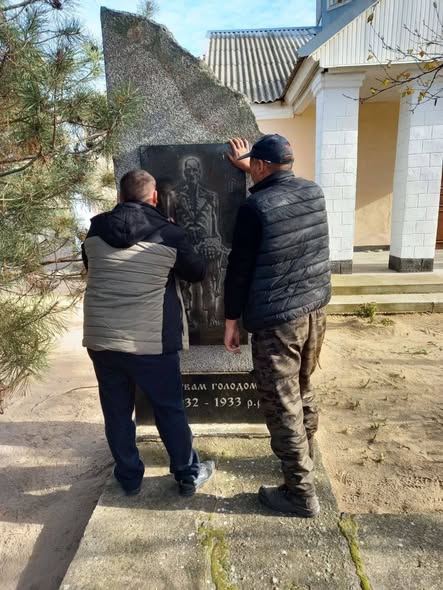
Thirteen months later, Russian-installed administrators in occupied Kherson Oblast began demolishing Holodomor memorials in Nova Kakhovka and the Oleshky community, calling them "a tool for manipulating history, artificially created to incite hatred towards the Russian Federation."
Echoes of the Past: Russia’s Starvation of Oleshky
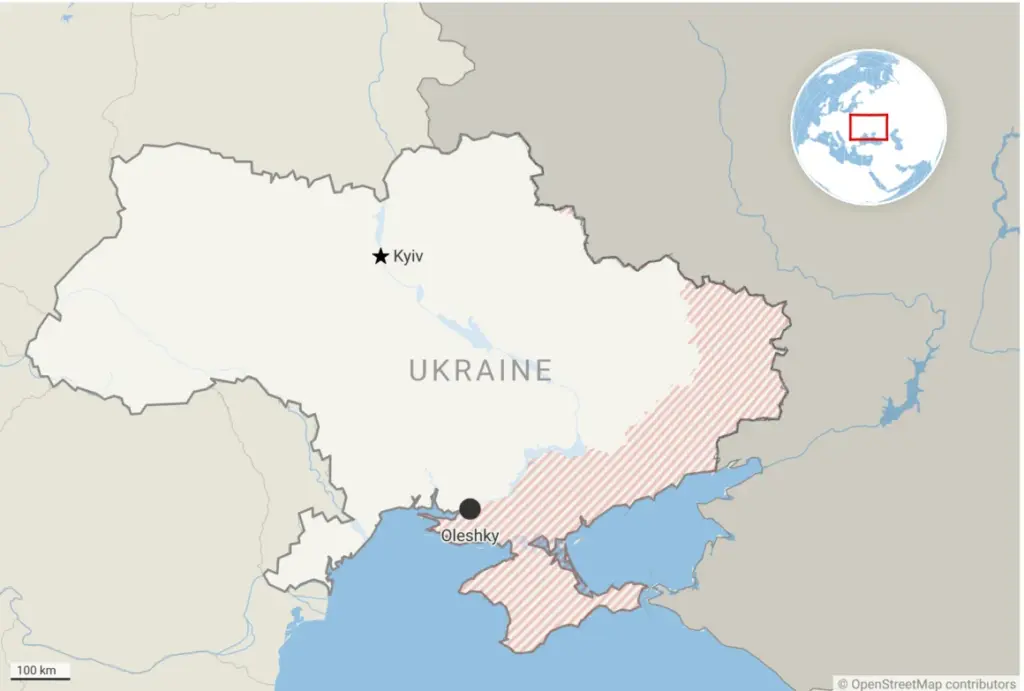
Many of the methods employed by the Russian occupying forces in Ukraine are redolent of those of the Holodomor. In occupied Oleshky, Moscow's troops have blocked off access to medical supplies and food while sequestering residents within the settlement's limits. Stalin's Politburo used a similar logic—blacklisting whole villages that fell short on grain quotas and barring peasants from leaving the Ukrainian republic in search of food.
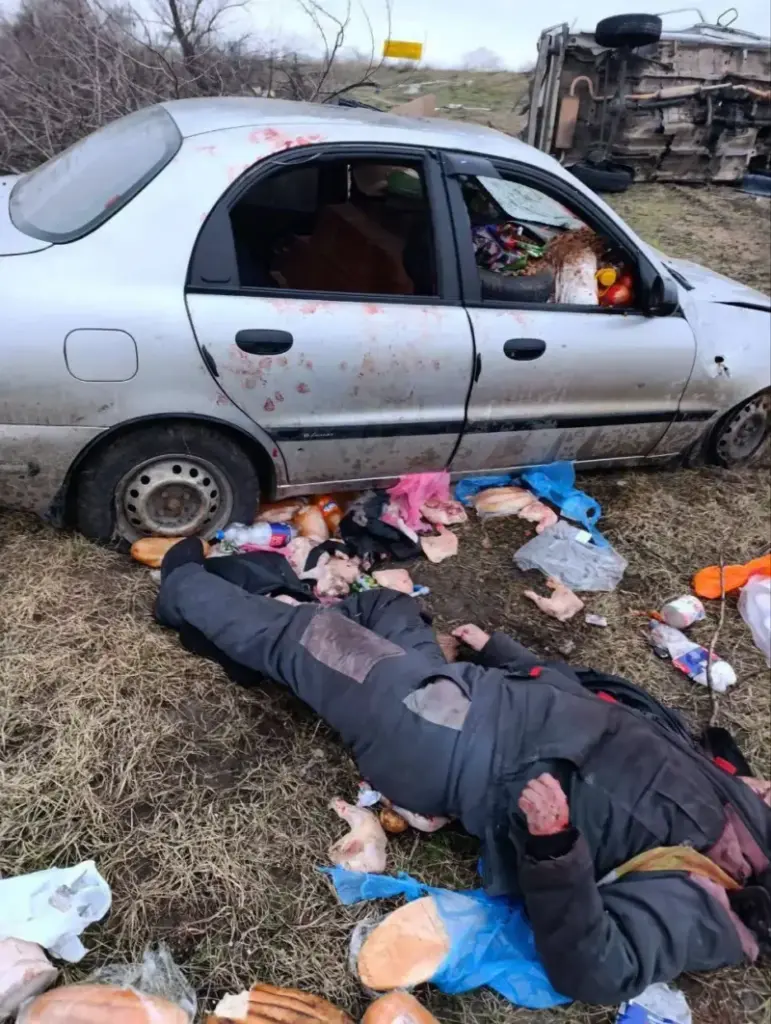
About 600-3,000 residents remain in the town (estimates vary widely amid ongoing hostilities), where the hospital ran out of antibiotics and painkillers long ago, bodies lie uncollected in the streets, and Russian soldiers steal what little food makes it through. Parliament Commissioner Dmytro Lubinets calls Russia's siege deliberate terrorism.
This material was produced as part of a project by the Institute of Mass Information with the support of the Ministry of Foreign Affairs of the Netherlands. The content of this publication does not reflect the official position of the IMI or the Kingdom of the Netherlands.
Read also
-
11 Holodomor questions Russia doesn’t want you asking
-
Mined in, starved out, hunted from above—life in the towns Russia demands at the peace table
-
Poll: 92% of Ukrainians see Holodomor as genocide of Ukrainian people
-
Stalin’s genocidal Holodomor campaign of 1932-33. What we know vs the denialist lies
-
Ukraine’s Executed Renaissance and a kickstarter for one of its modern successors
-
Holodomor in Kharkiv through the lens of Austrian engineer: photo gallery