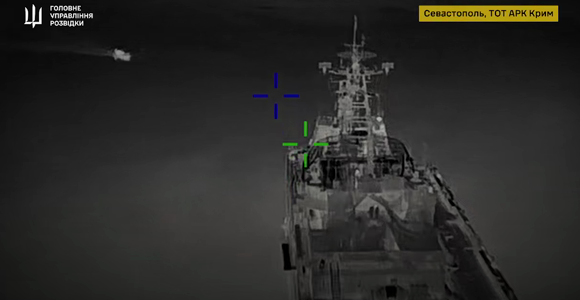
The Sevastopol Bay is turning into a zone of destruction for Russian amphibious forces. On the night of 19 April, a special unit of Ukraine’s Defense Intelligence (HUR) — the “Ghosts” — carried out strikes against two large Russian landing ships of the Black Sea Fleet.
According to HUR, both vessels were rendered inoperable as a result of the operation.
The targets were the Project 775 landing ship Yamal and the Project 1171 landing ship Nikolai Filchenkov.
The first vessel, built in 1988, can transport up to 500 tons of cargo, including armored vehicles and troops. The second, built in 1975, has a cargo capacity of up to 1,000 tons and is used for large-scale amphibious operations.
Russia’s Crimean surveillance network is being dismantled by precision strikes
During the operation, Ukrainian intelligence also destroyed the Russian “Podlyot-K1” radar system and struck the “Hvardiiske” fuel depot, significantly weakening air surveillance capabilities and logistical support for Russian forces in Crimea.
According to HUR, the radar system is valued at around $5 million. The General Staff of the Armed Forces of Ukraine confirmed strikes on the ships and additional targets in the occupied territory.
Russian Black Sea Fleet is steadily losing maritime dominance
Ukrainian forces continue to systematically reduce the combat capability of Russia’s Black Sea Fleet by striking ships, surveillance systems, and support infrastructure, gradually undermining its ability to control the Crimean maritime area.
Recently, the city of Tuapse in Russia's Krasnodar Krai came under drone attack overnight. Footage of a large-scale fire has spread across social media, attributed to a strike at the local oil refinery.
The previous attack on Tuapse took place only on 16 April. The Operational Headquarters of Krasnodar Krai finally extinguished the related fire on 19 April. More than 150 people and 49 units of equipment were deployed to put out the fire.
The refinery and the export pier form a single Rosneft production complex on Russia's Black Sea coast, about 550 km southeast of the war zone in Ukraine.