
Chornobyl forest fire spreads through mined areas amid wildfire crisis in Ukraine
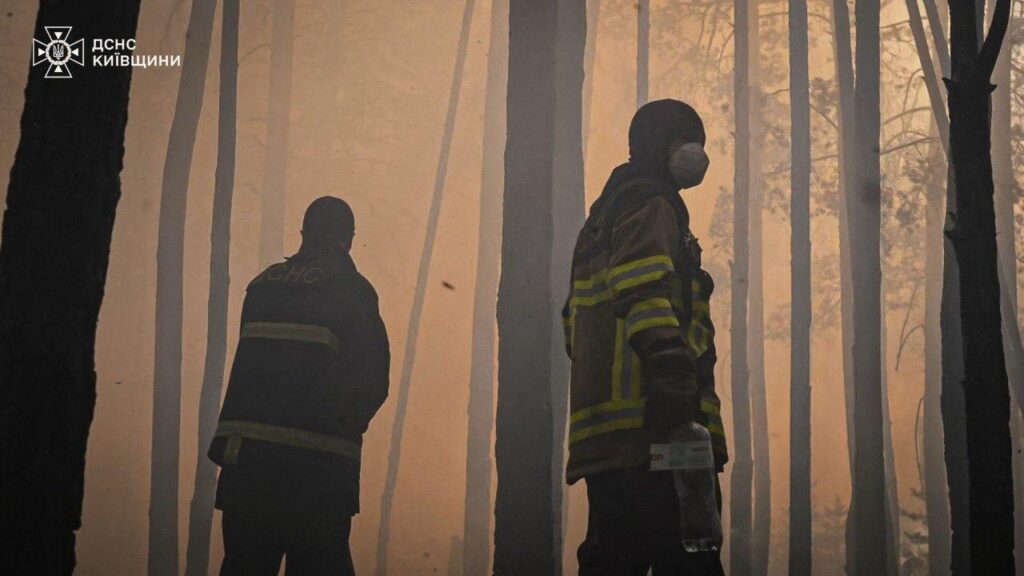

A large forest fire is spreading through Ukraine’s Chornobyl exclusion zone, with more than 1,100 hectares already burned as strong winds, dry weather, and mine contamination complicate firefighting efforts.
Ukraine’s State Emergency Service (DSNS) said the fire is rapidly advancing through new sections of forest in the exclusion zone north of Kyiv. Emergency crews remain deployed in reinforced operations to contain the blaze and prevent further spread.
Mine contamination blocks access to burning forests
Officials said some areas cannot currently be accessed because of explosive hazards left behind after Russia’s occupation of the area in 2022. Firefighting work has been temporarily suspended in several forest sectors due to the risk posed by mines and unexploded ordnance.
“The situation is complicated by dry weather, strong wind, and mine danger in some parts of the territory, which significantly limits firefighting operations,” DSNS said.
Environmental and radioactive risks
The Chornobyl exclusion zone remains highly vulnerable to forest fires because large areas are heavily wooded, difficult to access, and still contaminated following the 1986 nuclear disaster. Fires in the area raise concerns not only over environmental destruction but also over the possible release of radioactive particles trapped in soil and vegetation.
Emergency services said firefighters, specialized equipment, and personnel from other agencies are involved in the response. Crews are working to localize hotspots while shifting winds continue to spread the flames across the forest.
Wildlife groups warn of devastation to ecosystems
Animal rights organization UAnimals warned that the disaster is devastating wildlife in the area.
“News reports talk about hectares, but each of them is thousands of lives,” the group said in a statement, noting that forest fires destroy habitats and kill animals, including endangered species listed in Ukraine’s Red Book.
Nearly four decades after the world’s worst nuclear disaster, the exclusion zone has become one of Europe's largest de facto wildlife sanctuaries - home to deer, moose, roe deer, wolves, and hundreds of other species.
The organization added that even in peacetime, up to 90% of forest fires are caused by human activity, citing data from Kyiv Oblast’s civil protection training center. It said the war has further increased risks to forests and ecosystems across Ukraine.
Wildfires spread across four Ukrainian regions
DSNS said firefighters are currently battling nine wildfires across four regions, with the total affected area exceeding 2,000 hectares. Six of the fires have already been localized.
Alongside the large blaze in the Chornobyl exclusion zone, one of the most serious fires is burning in the Polissia Nature Reserve in Zhytomyr Oblast. Officials said the fire there has spread across roughly 500 hectares, with strong winds and high temperatures accelerating its advance.
Mine contamination is again limiting firefighting efforts. DSNS said some sections of the reserve remain inaccessible because of explosive hazards, forcing rescuers to suspend work in certain areas. Sappers have been deployed for demining operations, while drones and robotic equipment are also being used in firefighting efforts.
Border minefields and shelling threats complicate response
In Chernihiv Oblast near Ukraine’s border with Russia, another forest fire has burned an estimated 1,200 hectares. Emergency services said mine contamination, proximity to the border, and the threat of Russian shelling currently prevent the deployment of firefighting personnel and equipment. Forestry workers are instead creating mineralized firebreak strips to stop the spread of flames.
Meanwhile, in Rivne Oblast’s Sarny district, firefighters localized a forest fire covering 90 hectares.
Overall, 379 firefighters and 99 pieces of equipment have been deployed across all wildfire zones, according to DSNS. Officials said the overall situation remains under control despite the difficult conditions.