Belgium holds €183 billion in frozen Russian money. Why won’t it let Ukraine use it?
What’s the standoff?
Europe froze €183 billion in Russian central bank assets three years ago. Most of it is in Brussels at a financial clearinghouse called Euroclear. The money hasn’t moved since.
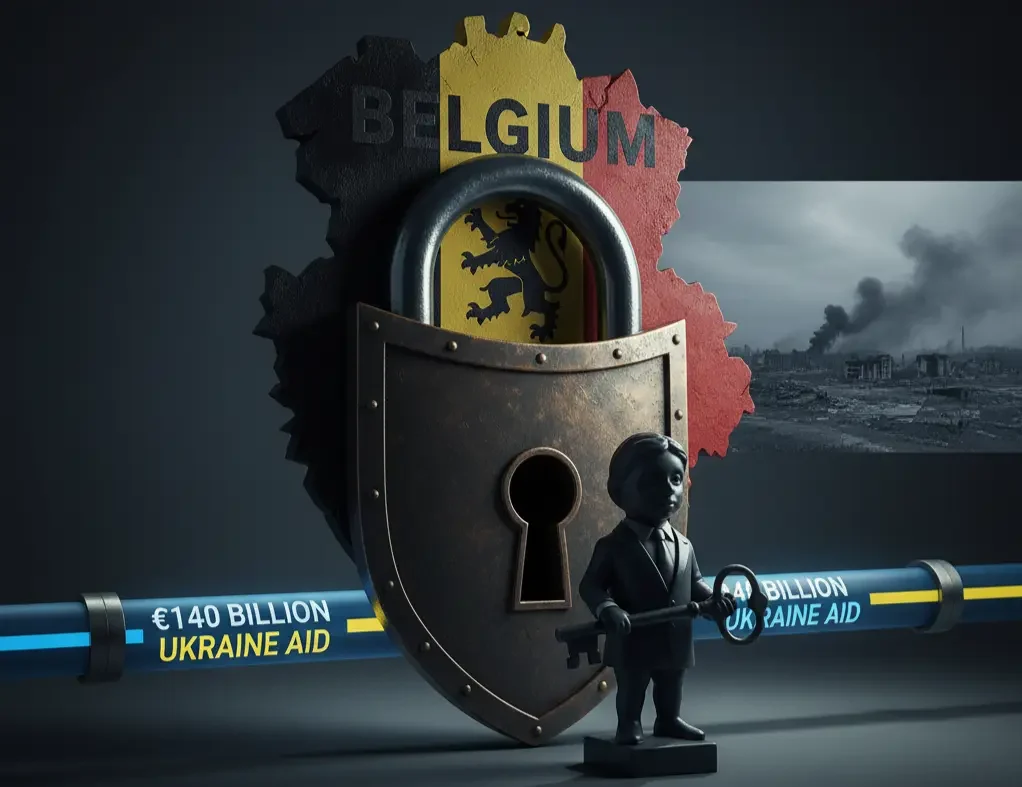
Now the EU wants to use that cash as backing for a €140 billion loan to Ukraine. Germany, France, Finland, Sweden, Estonia, Denmark—they’re all on board. German Chancellor Friedrich Merz calls it “increasingly urgent.”
Yet Belgium says no.
Prime Minister Bart De Wever has written to Commission President Ursula von der Leyen, calling the plan “fundamentally wrong.” Foreign Minister Maxime Prévot says the Commission’s latest proposal “does not address our concerns in a satisfactory manner.”
EU leaders vote at the Brussels summit on 18-19 December. That’s two weeks away.
Ukraine’s budget hits a wall in April.
Why does this matter now?
Ukraine needs €135 billion over 2026-2027 to keep fighting and functioning—military operations, pensions, hospitals, and schools.
The current funding model can’t cover that. The G7’s existing loan program uses only the interest earned on frozen Russian assets, not the principal. That generated €6.9 billion in revenue last year. This year, with falling interest rates, it’ll be closer to €5 billion. The trend is down.
Without the reparations loan, EU countries would need to fund Ukraine directly from national budgets. One deputy finance minister told Politico: “There’s no way.”
The Kremlin knows this. Putin isn’t negotiating seriously because he doesn’t have to—he’s betting Europe will exhaust itself before he does.
A two-year financing package backed by frozen Russian assets would break that bet.
What does Belgium want?
Belgium holds the leverage because Euroclear, where €183 billion sits frozen, operates from Brussels. The Belgian government owns a 12% stake.
De Wever initially set three conditions.
First: legally binding guarantees that all EU members share the risk if Russia ever reclaims the funds. “Taking Putin’s money and leaving the risks with us—that’s not going to happen.”
Second: France and Luxembourg, which hold €19 billion and €10 billion respectively, must participate. “The fattest chicken is in Belgium, but there are other chickens around.”
Third: legal clarity on the whole mechanism.
Now he’s moved beyond conditions. The approach itself is wrong, De Wever says.
Foreign Minister Prévot laid out the nightmare scenario: “If Russia takes us to court, it will have every chance of winning, and we will not be able to repay those €200 billion. It would mean bankruptcy for Belgium.”
There’s also money at stake today. Belgium collected €1.7 billion in taxes from Euroclear’s earnings on frozen Russian assets in 2024. Under the proposed EU mechanism, the revenue flows directly to Ukraine. Belgium loses the income and the control.
Are those fears realistic?
The Commission has tried to address them. Its latest proposal uses Article 122 of the EU treaty—an emergency solidarity clause—to change how sanctions work. Instead of requiring unanimous renewal every six months, a qualified majority could extend them. That would prevent, for example, Hungary or any other country from vetoing sanctions and forcing assets to be returned to Russia.
Belgium still isn’t satisfied.
Most analysts think the fears are overstated. Economist Timothy Ash has argued Belgium is “closing a barn door that’s been open for three years.” Europe sent its message in April 2022 when it froze the assets. If major reserve holders were going to flee in protest, they would have. China didn’t move its money. Saudi Arabia didn’t either.
On litigation: the Make Russia Pay coalition—a Ukrainian advocacy group funded by the EU—argues that the 1989 Belgium-Luxembourg-Soviet Union investment treaty provides only general language, and that Russia’s Central Bank has minimal chances of winning an arbitration claim.
And Europe has built shields. In July 2025, the EU Council prohibited recognition of arbitral awards related to disputes over these measures. EU courts cannot enforce a Russian legal victory.
Veerle Colaert, professor of financial law at KU Leuven, told the BBC that Belgium’s concerns have some merit—Euroclear does have obligations to return the money if sanctions are lifted. But she acknowledged: the EU could borrow on markets instead. “In both cases, Europe has to pay back. The advantage of taking the money from Euroclear is that it’s interest-free—but it is not risk-free.”
The question is which risk Europe prefers.
Didn’t Europe already seize Russian assets—for itself?
Yes. That’s where Belgium’s caution starts to look inconsistent.
In May 2025, Euroclear prepared to redistribute €3 billion from frozen Russian holdings. Not to Ukraine—to Western investors who lost money when Moscow confiscated their assets in retaliation for sanctions.
For years, Brussels said seizure was legally impossible, too risky, a danger to financial stability. Then, European investors needed compensation, and the EU found a way.
The bloc amended its sanctions framework in late 2024 to allow these payments. Euroclear informed clients that it had the authorization to “unfreeze the compensation amounts.”
So when European banks need protecting, the legal creativity flows. When Ukraine needs defending, Belgium demands ironclad guarantees first.
Make Russia Pay coalition notes that Europe showed “remarkable flexibility and willingness to take risks” when its own depositories were at stake.
The precedent exists. The mechanism exists. What’s missing is the will.
Is taking Russia’s money even legal?
This is the question underneath everything else.
Private property law states that ownership entails three key aspects: the right to use, the right to benefit, and the right to dispose. Russia’s central bank still technically “owns” the €183 billion. So isn’t this theft?
International law works differently. The relevant rules aren’t about property—they’re about responsibility and consequences.
There’s a framework called ARSIWA: the Articles on Responsibility of States for Internationally Wrongful Acts. It’s essentially the UN’s rulebook for what countries can do when another country wrongs them. One tool: countermeasures.
Countermeasures let an injured state suspend the wrongdoing state’s rights—not as punishment, but as pressure to force compliance. The key words are “temporary,” “reversible,” and “proportional.”
Russia owes Ukraine over $1 trillion in war damages. The November 2022 UN General Assembly resolution, backed by 94 countries, affirmed that Russia must pay compensation. Ukraine has registered over 60,000 claims. A Claims Commission convention finalizes on 16 December—two days before the EU summit.
The €140 billion wouldn’t be seized. It would be credited against Russia’s existing debt. If Russia pays reparations, this amount is subtracted. If Russia never pays, Ukraine keeps the money as partial compensation.
That’s why EU officials avoid the word “confiscation.”
As Mykola Yurlov from Ukraine’s Foreign Ministry put it: “You can take the assets of another state if that state is waging a war against the international order.”
Novel? Yes. Unprecedented? Yes. Illegal? The experts say no.
Has Ukraine made this harder than necessary?
Probably.
Iryna Mudra, Deputy Head of the Office of the President, has outlined Ukraine’s position: no conditionality on how funds are used, complete autonomy in setting priorities, and freedom to direct money toward defense—including salaries.
Both Ukrainian anti-corruption activists and the EU pushed back. Brussels ties financial support to reform benchmarks. That’s standard for candidate countries. Demanding blank-check access while asking Europe to take unprecedented legal risks doesn’t help Kyiv’s case.
Neither does this: On 28 November, Andriy Yermak—Mudra’s boss and Zelenskyy’s right-hand man for five years—resigned after anti-corruption investigators raided his home. The Energoatom scandal involves alleged $100 million kickbacks at Ukraine’s state nuclear company. It’s the largest corruption investigation of Zelenskyy’s presidency.
Demanding “complete autonomy” over EU billions while your office is under investigation hands ammunition to every skeptic in Brussels, Washington, and Budapest.
The scandal won’t kill the reparations loan. But it makes the politics harder at the worst possible moment.
What happens next?
Two dates to watch.
16 December: The Claims Commission convention meets in The Hague. This body will formally process reparations claims against Russia—giving the “set-off” mechanism legal infrastructure. The €140 billion becomes a down payment on a recognized debt, not just frozen cash.
18-19 December: EU leaders vote at the Brussels summit.
Von der Leyen has offered three paths forward:
- Direct grants from member states—budgets are stretched; politically painful
- EU-backed borrowing—adds to collective debt; slow
- A loan backed by frozen Russian assets—cheapest, fastest, no new EU debt
Option three makes Russia pay for the destruction it caused.
Belgium’s counterproposal: a €45 billion loan from existing EU budget provisions. That covers barely a third of what Ukraine needs through 2027.
Moscow calls it theft. Kyiv calls it justice. Brussels calls it complicated. Belgium calls it someone else’s risk.
Two weeks to decide.